Showing posts with label charleston. Show all posts

Saturday, April 19, 2014

Navy 'Changed Trajectory of the War'


1862 illustration shows captured British blockade runners. (U.S. Navy)
 
The Navy "changed the trajectory of the war" was the way one of the nation's leading historians described the service's contribution to the ultimate Union victory in 1865.

Speaking April 16 at the United States Naval Institute's annual meeting in Washington, Dr. Craig Symonds, co-winner of the 2009 Lincoln Prize for his Lincoln and His Admirals, said the blockade of Confederate ports from the Carolinas on the Atlantic to the Texas Gulf Coast "was the largest enterprise the Navy undertook," ultimately involving more than 500 ships, more than 400 of them converted merchantmen -- "the last time that was still possible," and 100,000 men.

The Union Navy transformed itself from a fleet of 42 ships scattered around the globe or in ordinary at shipyards with a few thousand officers and experienced tars in 1861 to a technologically adept force with rifled guns, iron-plated, screw propellers, etc. operating with a "changed lower deck" of "volunteers. contrabands from the South, free blacks from the North" in 1865.

When President Abraham Lincoln announced the blockade, Symonds, a professor emeritus of history at the Naval Academy, contends that he and Secretary of State William Seward understood that it "was an act of war" and implied "a kind of recognition" of the Confederacy.

But it proved hugely advantageous for the Union.  Great Britain. while acknowledging the Confederacy as a belligerent, declared itself neutral in the North American war and by doing that effectively closed off its ports, particularly important in the Caribbean, to Confederate privateers or later its commerce raiders trying to sell off their captured "prizes."

But the reality of blockade is actually far more difficult than simply declaring it.  "You actually have to do it" over 3,500 miles of coast with 189 harbors and navigable inlets. "Maintaining it was hard work.  Blockade service [meant] days that were long and tedious ... in all weather.  Usually at night and often in rain or drizzle, the blockade runners were creeping in and out of Southern ports.

It did work on a number of levels, Symonds said, including persuading a large number of foreign ship-owners never to risk their vessels in a race for safety and riches in a Confederate harbor. The blockade caused "the slow asphyxiation" of the rebellion and "very likely made the war shorter."

With the profit motive of privateering proving to be a myth, the Confederacy turned to buying ships overseas for commerce raiding.  Led by James D. Bulloch, a onetime officer in the United States Navy and experienced merchant marine officer, the Jefferson Davis government put to sea a "dozen or so" of these ships, most notably Alabama that destroyed 284 American merchantmen over the course of the war. 

Indeed, the Confederate Navy's Civil War didn't end until November 1865 when Shenandoah returned to Liverpool, having destroyed a number of American whalers operating in the Pacific -- after Robert E. Lee's surrender at Appomattox.

The commerce raiders were an interesting story all their own.  They were officered by Confederates, but the overwhelming majority of the crew were British, Scot, Irish and French "who didn't think much" of promises of future fortunes for all when the Union threw in the towel.  "They were in it for the money" immediately. When the prize money remained empty promises and the risks great, many deserted.

Commerce raiding "was a great idea for the Confederacy" because it caused maritime insurance rates to skyrocket and caused American-flagged vessels to change registry  to avoid destruction.

But in the end, the commerce raiders "did not bring Lincoln to the negotiating table" nor did they weaken the blockade.

For the greater part of the war, the Army and Navy operated separately even when fighting in the same area. Think New Orleans; think Charleston.  Yet from the war's start on the  rivers lying west of the Appalachians to the Mississippi, combined operations proved very successful at Forts Henry and Donelson and Island Number 10 -- keeping Kentucky in the Union and splintering Tennessee. Joint operations also set the stage for Maj. Gen. Ulysses S. Grant to take his army from positions west of Vicksburg, Miss., where it had been stymied for months  to crossing the river and laying a siege that closed off any escape to the east by large numbers of Confederate soldiers now trapped in the river city.

Effective but time-consuming.

More dramatically, at New Orleans, then Capt. David Glasgow Farragut didn't wait for the Army and blasted his way past the forts below the Confederacy's largest city and most important trading port to capture the city with ocean-going frigates in the spring of 1862.

Official Washington loved that dash and rewarded Farragut with promotion.  The Navy Department wanted more of it. Its leadership thought it had just the man, Capt. Samuel F. DuPont, who had captured Port Royal, S.C., and turned it into the base for the Atlantic blockade. And, more to the point, he would have ironclads. 

At Charleston, DuPont certainly felt the heat from Assistant Navy Secretary Gustavus Fox and to a lesser extent from Navy Secretary Gideon Welles to keep his attack on the birthplace of secession an "all Navy affair." The "attack." in spring 1863" was a disaster.  The invincible ironclads of Fox's and Welles' dreams were ineffective, at best.
Mine and obstacles channeled the vessels into deadly fields of fire from artillery ashore and in the island forts.  The ironclads minus disabled Keokuk   had no choice but to retreat to safety.  Keokuk eventually sank off Morris Island. In fact, Charleston remained in Confederate hands until the last few weeks of the war when i

Sunday, January 5, 2014

The Moral Courage in Risk Taking

The Navy was more successful in its campaigns like Port Royal, S.C. and New Orleans than the Army during the American Civil War particularly in the Virginia Theater.  According to Pulitzer Prize-winning author James McPherson, it was “partially due to the professionalism of Navy leadership in high positions."  Dr. McPherson answered these and other questions on 4 January during a speaking engagement at the Society for Military History George C. Marshall lecture series in Washington, D.C. 

James McPherson discusses the role of naval operations in the war in his most recent work, War on the Waters: The Union & Confederate Navies, 1861-1865.  Concerning his talk, he argued that “determined commanders can make [some of] their own luck," as Ulysses S. Grant and David G. Farragut did at Vicksburg and Mobile Bay, respectively. 

Both Grant and Farragut shared the "moral courage to take risks and accept failure." Citing Farragut's decision to press forward at Mobile Bay after his lead ship Tecumseh struck a mine and sank, while Brooklyn, second in formation, veered off course and stopped.  It was at this point that Farragut could have said, “Damn the torpedoes!”  He added that Mobile Bay “was the first unequivocal Union victory of 1864," followed by Maj. Gen. William T. Sherman's takeover of Atlanta and Brig. Gen. Philip Sheridan's burning of Virginia's Shenandoah Valley.  McPherson stated that these three victories secured Lincoln's re-election and the Union's determination to win the war.

Farragut knew all too well about the willingness to accept failure and take risks.  Farragut spent sixty of his sixty-nine years in the Navy.  Despite this, his loyalty came into question at the beginning of the war.  According to McPherson, he "was the opposite" of Flag Officer Samuel F. Du Pont.  At Charleston, Du Pont found himself constantly at odds with Navy Secretary Gideon Welles and Assistant Navy Secretary Gustavus V. Fox over the practicality of taking the South Carolina port "in an all Navy affair."  He wanted to do as he did at Port Royal earlier in the war.  He would be backed up this time by the latest class of ironclad Monitors and a specially constructed frigate, New Ironsides, to run the harbor's ring of batteries, forts, and waters filled with mines and deadly obstructions.

To Lincoln, Welles, and Fox, Du Pont's pessimism about the ability "to beat our Southern friend and beat the Army" in subduing Charleston sounded more and more like the letters sent by Maj. Gen. George B. McClellan's explaining why the Army of the Potomac failed to move against the Confederates after success at Antietam.

Du Pont, who spent 45 years in the Navy and served on the Blockade Strategy Board in the beginning of the war, told Fox to “think cooly.”  "There's no running the gauntlet of forts like [Farragut did] at New Orleans" as he pressed repeatedly for a combined Army-Navy operation with the soldiers taking the batteries and forts with supporting fire coming from the Union fleet in covering their attacks.
McPherson felt that Farragut believed he would "have found a way" to carry out the attack that the president and civilian Navy leadership wanted. When Du Pont finally attacked, his fleet of ironclads managed to get off 151 shots while the Confederates, having set up range finders all around the harbor, fired 2,209 rounds.  Over five hundred of those struck Union ships, sinking the ironclad Keokuk in the process.  After a council of war with his ship commanders, Du Pont, who originally considered pursuing the assault the next day, "decided not to pursue the attack."  Quoting from Welles' diary said, McPherson said that Du Pont "had a reputation to protect not to make," and like McClellan that sealed his fate.  Despite his good family name and pedigree, Du Pont was removed from command. He left his position as "a bitter and broken man unwilling to take risk."

In the public's mind and the administration's, the Navy “was expected to do the heavy work" in the taking of New Orleans, as it had at Port Royal.  Later successes, even Mobile Bay, were given little public recognition at the time, an oversight that is changing now.


Gideon Welles was also a risk taker.  He did not adhere to the Navy's reliance on seniority to promote commanders, McPherson said.  With Farragut, he found a commander who would take those risks.  When Virginia seceded, he "stood by the flag” despite his local connections.  Before leaving for New York in the spring of 1861, Farragut presciently warned his friends and in-laws in Norfolk:  "you fellows will catch the devil for this business."  Welles was not so lucky with Du Pont and Charleston. He wrote in his diary, "If anything is to be done, we must have a new commander.”  He tapped the president's naval confidante, Flag Officer John A. Dahlgren, for the position.  Dahlgren would fare little better than Du Pont at the seat of secession.

Tuesday, August 27, 2013

"So Here is a Nice Mess:" The Navy Shells Wagner and Sumter from Land and Sea at Charleston


This watercolor, titled "View of Charleston Harbor and its Defenses," shows the Navy and Army siege lines
on Morris Island.  The Navy Battery is on the left and the ironclads can be seen on the far right.
Having failed to take Fort Wagner by direct assault, Brigadier General Quincy Gilmore elected to start a formal siege operation against Confederate defenses. His plan was to blast the Confederate out of their positions in a similar manner to siege operations conducted against Vicksburg and Port Hudson. He also expanded the target list to include Fort Sumter. The problem Gilmore faced was the same problem faced by Union ground forces out West: a lack of heavy guns.  Like the sieges of Port Hudson and Vicksburg, the Navy came to the Army's aid.

Rear Admiral John Dahlgren furnished the necessary resources. He provided two English-made 70-pounder Whitworth Rifles (captured from a blockade runner), two 200-pounder Parrott Rifles, and five 100-pounder Parrott Rifles. In addition, sailors and soldiers dragged ten mortars into position (an excellent discussion on the Naval battery's particular guns and the batteries can be found at Craig Swain's "Marker Hunter" blog).
Navy gun crews with the Whitworth Rifles

Dahlgren assigned Commander Foxhall Parker, Jr. to oversee the newly designated "Naval Battery" and "Naval Brigade." Parker served as Dahlgren's adjutant for the squadron aboard USS Wabash and gave the commander leeway in finding the necessary sailors and marines to man and protect the guns. In a major concession to Army-Navy cooperation, naval units on shore fell under Gilmore's command.

This is not to say Dahlgren and his ships would stand idly by. The admiral assigned two monitors, Passaic and Patapsco, to take aim at Fort Sumter from 2,000 yards out. Four other Union monitors (WeehawkenCatskillMontauk, and Nahant) took aim at Fort Wagner, with New Ironsides and several wooden gunboats in reserve.

Harper's Weekly's Theodore Davis' interpretation of
the Navy Battery firing at Fort Sumter. 
The bombardment from land and sea on Forts Wagner and Sumter began on August 17th and last through the 24th. Dahlgren and Gilmore were cordial during the first four days of the bombardment. Things went a little sour on the 21st when Gilmore asked the monitors to suppress Wagner's sharpshooters.  Dahglren frequently stated to Gilmore that he could have the monitors at any time.  In this case, however, Dahlgren explained the finer points of tides and currents to the general and concluded that his ships could not simply charge in whenever needed.

Dahlgren's sketch of the position of his ironclads during the August
17th bombardment of Fort Wagner and Battery Gregg.
Surprisingly, Gilmore was not offended.  He changed his tune when he asked Dahlgren to leave Wagner alone, and go all in with all his ironclads at Fort Sumter at close range. Once again, Dahlgren hesitated and explained the difficulties of attacking Sumter, namely the shallow waters around the fort. He finally decided on releasing two monitors, Passasic and Weehawken, to assault Sumter at close range. Both monitors ran aground during their attack.

But, Gilmore would change his mind several times about where he wanted the Navy's resources. Though Army-Navy cooperation had improved since Du Pont left, Dahlgren expressed major frustrations with his Army counterpart. It seemed that every time Dahlgren prepared to send his monitors at Sumter, Confederate sharpshooters from Fort Wagner would take aim at Gilmore's sappers.  Angered, Gilmore would demand the monitors to return. One telegram provided proof of Dahlgren's frustration. Gilmore signaled Dahlgren during the operation to "Send [the monitors] back, they are inspecting us with their spyglasses."

The end result of the seven day bombardment looked impressive. Several sections of the brick and mortar of Fort Sumter were smashed. Yet Sumter and Wagner remained in control of their respective garrisons. Dahlgren recalled several monitors for repairs caused by Confederate guns. The Catskill in particular took several critical hits. Wagner's guns struck Catskill seven times near the pilot house, which resulted in her commanding officer Commander George Rogers' death. In his final report on the operation to Secretary Welles, Dahlgren believed that he did not have enough ironclads to attack Sumter, suppress Wagner's guns, and perform other duties in Georgia. Thus, the operation ended in failure.

The Naval Battery recorded mixed results as well. Parker reported that his four gun battery fired 703 Parrott shells, 373 of which struck Sumter.  Over two hounded solid shots came from the Whitworth rifles. More shots would have come from the Whitworths if it wasn't for one that exploded, killing four sailors. A shell exploded after it became jammed half into the barrel. Sailors attempted to ram the shot further into the gun.

When Dahlgren heard that Passaic ran aground, he wrote in his diary, "So here is a nice mess."  It should have been his final conclusion for this particular operation.

Thursday, July 18, 2013

Siege of Charleston: Supporting the Charge of the 54th Massachusetts Volunteers


The Assault on Fort Wagner as published in 1890.
This interpretation of the famous charge of the 54th Massachusetts is
 one  of the  few that show the U.S. Navy's ironclads in action.
Amidst siege operations in Charleston,Union leadership decided to try and seize Fort Wagner. The fort commanded the southern approaches to Charleston Harbor. It was relatively isolated from other Confederate fortifications.  Thus, it could not count on help if attacked. 

Map of Morris Island and Fort Wagner
Rear Admiral John Dahlgren, commanding the South Atlantic Blockading Squadron, and Brigadier General Quincy Gilmore, commanding Union ground forces, agreed on a plan.  They planned to first seize the southern shores of Morris Island before beginning an assault on Fort Wagner on July 11.  The first part of the plan worked well.  A combination of four monitors (USS Weehawken, Nahant, Catskill, and Montauk), wooden gunboats, and small boats from the steam frigate USS Wabash equipped with boat howitzers, provided sufficient cover for a Union landing to overrun Confederate defenses. 

The monitors shelled Confederate positions from 4 a.m. until 12 p.m..  They then withdrew back out into open water "for lunch" promptly at noon.  Two hours later, the monitors resumed their firing positions. 

This assault on Fort Wagner itself did not succeed due to accurate heavy gun fire from Confederate gunners.  The Confederate gunners even damaged some of the monitors with a bolt type, armor-piercing shot. Union forces managed to establish a siege line during the melee. Gilmore planned a second assault on Wagner with five regiments.  The African American-manned 54th Massachusetts Volunteers lead the attack.

For the Navy's part, Dahlgren prepared six ironclads to support the operation.  The Federal force included the four monitors previously mentioned, plus USS New Ironsides, the monitor USS Patapsco, and three wooden gunboats. The steam sloop USS Housantonic stood back to observe where the ironclads' shots landed and to signal each ship the results. Additionally, Dahlgren put New Ironsides' Marines on alert, just in case they were needed in the ground assault.
  

Alfred Waud's drawing of USS Patapsco
 and other monitors off of Charleston.

The Navy bombardment began in the morning, with the squadron firing from 1,200 yards. Taking advantage of the flood tide, the ironclads moved west of the Main Ship Channel and closer to the fort.  At three hundred yards, the ironclads began a rapid fire bombardment.  Unlike the July 11 attack, the Navy's shelling kept the Confederate gunners from returning fire.

The ships kept up the fire until 7.30 p.m.  Gilmore signaled to Dahlgren that his troops were in position to assault.  Dahlgren ordered a cease fire due to a lack of light and a fear of hitting Union ground forces. The admiral reported that he witnessed flashes of gunfire from the ground assault until 9:30 p.m. Dahlgren wrote that the "ill-tiding of a repulse were not long in coming."  He received official word at 10:30 p.m. 

Supporting the second assault, the Navy unloaded about 1,945 shells (mostly XI-inch shells, but also some XV-inch shells, 150-pound and 100-pounder rifle shells) on Fort Wagner.  The number is a bit misleading, as New Ironsides accounted for 1,120 of them, the wooden gunboats 200, and the monitors about 625.  The broadside ironclad out-fired all the monitors combined.  In all, the squadron fired 432,676 lbs, or a little over 216 tons, of ordnance at Fort Wagner. During the bombardment, a disturbing trend arose.  Critical breaches occurred on three of the squadron's Parrot Rifles.

Dahlgren concluded that the plan was sound, but more troops were needed for the ground assault.  Additionally, he held high praise for the Army's assault.  He wrote, "the loss sustained by our troops bears witness to the preserving gallantry with which they endeavored to storm the work, and which deserve, I trust, a renewed effort."


Friday, June 7, 2013

Civil War Navy Special Edition Daybook-Sea Stories-Now Online


The next issue of The Daybook is now online.  This issue is our third "Special Edition" installment on the Navy's role in the American Civil War.  This issue took a different approach than most of Daybooks.  Inside the reader will find the Civil War at Sea unfiltered.  The participants of the war are going to speak to you directly without a historian interpreting the events.  All parts of the war at sea are covered.  From the shores of France where two cruisers battle it out, to the siege lines of Charleston, to the corner of the Confederacy where a lone blockade runner attempted to put to sea. 

Some of the articles one will find are March 9, 1862 log book entry of USS Monitor (which sums up the entire Battle of Hampton Roads in ten sentences); excerpts from the logs books U.S. Navy ironclads on the front lines; excerpts from an African American sailor serving in the U.S. Navy; the day the Navy took a dog and sheep into custody; letters to home from a grief stricken officer; and Admiral David Dixon Porter's surreal conversation with a plantation overseer.

If you would like a print copy of the Daybook, head on over to the Hampton Roads Naval Historical Foundation's page and become a member!

Thursday, May 16, 2013

The Capture of Georgina and Some Furry Friends

The English-built steamer Georgina had the potential to be one of the most effective ship ever to serve in the Confederate States Navy. She was a large steamer with a good size hold for cargo and had several placement for large caliber guns. Like many of the English-built cruisers, great secrecy surrounded her construction. It is still not clear whether the Confederacy intended her to be a commerce raiding cruiser or a blockade runner.

During her maiden (and only) voyage  in the Spring of1863, she was definitely a blockade runner.  Loaded with small arms, naval artillery, black powder, money, and alcohol, Georgina attempted to the run into Charleston. She did not make it.  U.S. Navy ships USS America, Wissahockon, and Housatonic spotted her and opened fired.  The shots struck Georgina.  During the chase, Georgina's captain committed a serious navigation error, causing the ship to run hard aground. He and the ship's company immediately abandoned ship.

Wissahockon's commanding officer ordered a boarding team to take possession of the ship and "all prisoners."  One of Wissahockon's division officers, Lieutenant Israel Vail, in his excellent memoir Three Years on the Blockade, tells us what happened next:

"A boat was immediately lowered from our ship, and Lieutenant Casey was sent to board the stranger, with orders to bring back the prisoners with him, and to ascertain what cargo she had, and get such other information as he could by an examination of her papers. It was past midnight, but we all sat up and waited patiently for the return of the boat, as we were anxious to see the prisoners and hear all the particulars about the ship.

In due time the boat returned bringing the prisoners, which consisted of a large Newfoundland dog and a very large Southdown sheep. Lieutenant Casey had obeyed his instructions to the letter, so far at least as the prisoners were concerned, for the dog and sheep were the only living things to be found on board the vessel, and these amiable animals had met him at the gangway as he stepped on board, and gave him a hearty welcome, at the same time indicating their willingness to surrender, without any words on the subject.

The arrival of these unexpected prisoners caused an immense amount of amusement for us, as we all crowded to the rail to see them hoisted on board, and the Lieutenant seemed to be very proud of his peaceful capture. He reported that he had made a thorough examination of the ship in search of officers and crew, whom it was possible might be stowed away somewhere among the cargo, but, that he could find no trace of any living beings except the prisoners mentioned. So he had concluded that all hands had escaped to the shore in their boats, as soon as the ship had struck the bar. Signals were at once made from our ship for assistance in getting the stranger off the bar, and in a few minutes several boats arrived from the other blockading ships, and preparations were made for hauling her off.

There was no manifest of the cargo found, but it was presumed that she was loaded with arms and ammunition, as a portion of the cargo was in sight, and consisted of small rifled cannon and Enfield rifles. There must also have been a considerable quantity of medical stores on board, as quite a number of bottles of quinine were found, as well as several cases of brandy. The quality of the latter article was tested.”

Wednesday, April 24, 2013

USS America-The Most Famous Civil War Ship You've Never Heard Of


It may come as a surprise to some Civil War naval aficionados that there was a ship serving on the South Atlantic Blockading Squadron as famous as MonitorHartford, or Alabama.  The schooner USS America should be added to that list.  The America was small by nineteenth century warship standards.  She did not possess iron plates or a steam boiler.  No well known officer ever controlled her helm.  Nonetheless, her name is legendary to people who compete in sailing regattas. 

In 1851, British royalty donated a trophy called the 100 Guinea Cup for the Royal Navy Yacht Club's annual race around the Isle of Wight.  Determined to win for the United States, a nine man syndicate known as the New York Yacht Club commissioned the construction of a gaff schooner-rigged yacht.  The ship was christened America.  After defeating fifteen British ships in front of Queen Victoria, the men brought the Cup to the United States.  They donated the trophy to the Club to serve as the award for an international sailing competition.  They renamed the cup and competition the "America's Cup," in honor of the yacht’s accomplishment.  Every four years, professional sailors and their sponsors compete for the Cup.
 
Despite their success, the syndicate sold the schooner to a British lord soon after the race.  After passing through a few other hands, the vessel finally landed with another member of British royalty, Henry Deice.  According to Edward Sweet, author of The America: War Service of a Racing Yacht, Deice's background was always a mystery.  He frequently changed his name in correspondence.  It is plausible that he lied about being a British lord. Nonetheless,  Deice committed the ship to Confederate service at the beginning of the war to be used a courier/blockade runner out of Jacksonville, Florida.
 When Union forces captured Jacksonville, they found the yatch scuttled in the St. Johns River.  Determining the vessel was worth saving, the Navy salvaged the schooner and sent her to the Washington Navy Yard for repair.  While there, Naval ordnance expert John Dahlgren gave the vessel a 24-pounder and two 12-pounder bronze cannons.  Commissioned as USS America, the Navy assigned the fast sailing schooner to the South Atlantic Blockading Squadron.  Despite its light battery and small size, America and her commanding officer, Acting Master Jonathan Baker, captured or chased ashore several blockade runners.  Her captures included the schooner David Crocket and the steamers Georgina and Stonewall Jackson.

Given the advance in maritime technology, it may seem odd for the Navy to use sailing ships for war service.  Since these little vessels (only 170 tons displacement) were fast, drew little water, and required little upkeep, senior officers coveted these ships.  Many complained loudly when the Department ordered them off duty.
After the war, the Navy kept the yacht as a training vessel at the U.S. Naval Academy until it was sold to General Benjamin Butler.  She survived until the 1940s. A replicia of the vessel sails on the West Coast of the United States.
The 2013 America's Cup will be held in San Francisco, California.

Sunday, April 7, 2013

150 Years Ago: The Ironclads Attack Fort Sumter!

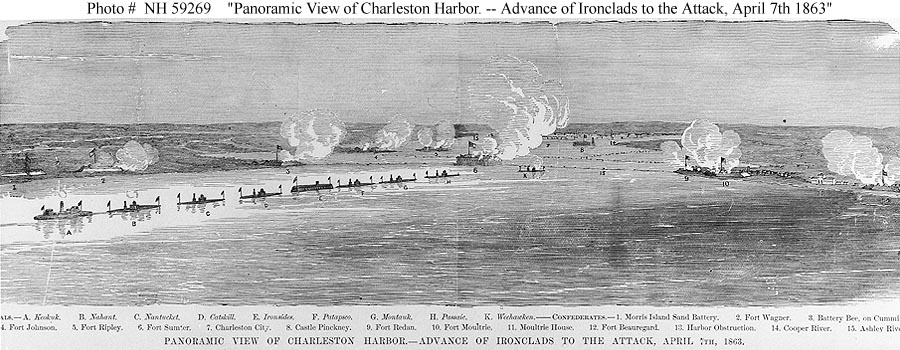
At noon on April 7, 1863, the largest concentration of ironclad warships yet seen in the Civil War prepared for action in the main ship channel leading to Charleston harbor.

The attack which was the culmination of several months of planning, debate, and no small amount of political pressure. One might argue that Charleston, South Carolina was not a significant objective for the northern war effort. But it was a port which had to be blockaded. And more importantly, it was symbolically important as the place where secession first took root. Capturing the city would provide a major boost against war weariness in the north, while dispiriting the south.

The overall plan was for an Army-Navy team to move on Charleston in the spring of 1863. Ironclads assembled at Hilton Head throughout the winter (minus of course the USS Monitor which was lost at sea). By late March, the force included seven monitors, and the the USS New Ironsides and USS Keokuk, of competing ironclad designs. On land, the Army had roughly 25,000 men on the South Carolina coast under Major General David Hunter to cooperate with DuPont's ironclads. Sounded good on paper, but more than a few obstructions lay in the way. DuPont was not confident the ironclads could achieve what was planned. And at the same time Hunter was less than predicable with his support.

The ironclads crossed over the bar into the main ship channel at Charleston on April 5. The force waited on tide, wind, and weather to move at the most opportune hour. DuPont arranged his ironclads into a line ahead - USS Weehawken, USS Passaic, USS Montauk, USS Patapsco, USS New Ironsides (also DuPont's flagship), USS Catskill, USS Nantucket, USS Nahut, and USS Keokuk. The Weehawken carried a "jack boot" raft fixed to the bow as a means of dealing with harbor obstructions and torpedoes known to be in the channel.
 DevilRaft1

 DuPont's orders called for the ships to close within 600 to 800 yards of Fort Sumter before opening fire. The gunners were told to focus on the center embrasure of the fort's northeastern face. The intent was to reduce the fort.
 FortSumterNEFace1
 The term "reduce" indicated DuPont's objective was to not only silence the guns of Fort Sumter, but to render it useless as a defense. By concentrating fires on the center of the wall of the fort which most closely fronted the ship channel, this would ensure follow on, non-armored, ships could more easily pass. The instructions assumed the XV-inch and XI-inch Dahlgrens along with the 150-pdr Parrott rifles of the ironclads could make short work of the brick structure. After all, didn't heavy artillery of this sort breach Fort Pulaski only a year earlier?

The ironclads pulled anchors at around noon. But almost immediately the movement fell behind schedule. The chain of the Weehawken, commanded by Captain John Rodgers, became entangled with the raft on the front of the ship. Not until 2 p.m. did the ships proceed. About an hour later, the Weehawken came under long range fire from the guns of Fort Moultrie. Rodgers reported "The accuracy of the shooting on the part of the rebels was very great, having been attained, no doubt, by practice at range targets, since I remarked that as we passed a buoy all the guns opened at once."

CharlestonIroncladAttack

Rodgers moved the Weehawken close enough to observe the obstructions placed between Fort Sumter and Sullivan's Island. But in the process his ship receive at least 53 hits. A torpedo exploded close to the ship, but caused no damage.

Behind Rodgers, Captain Percival Drayton in the Passaic also moved close enough to observe the obstructions. The Passaic received thirty-five hits including one which disabled the ship's XI-inch gun. One heavy caliber rifled projectile, likely from one of the 7-inch Brookes in Fort Sumter, "struck the upper edge of the turret, broke all eleven plates, and then glancing upward took the pilot house, yet with such force as to make an indentation of 2 ½ inches, extending nearly the whole length of the shot." The sum of damage was so great that Drayton briefly pulled the Passaic out of line.

In the Montauk, Captain John Worden found keeping station against the flood tied while in close proximity to obstructions and other ships to be more dangerous than the Confederate fire. The rebels struck the Montauk fourteen times, "but received no material damage."

The fourth ship in the line, the Patapsco, under Captain Daniel Ammen, opened fire at 1,500 yards on Fort Sumter with its Parrott rifle. Like Worden, Ammen found station keeping difficult while in action. The Parrott rifle was soon out of action due to a broken cap square. Projectiles hitting the turret caused difficulty traversing, so the Patapsco was unable to respond with sustained fires. Forty-seven Confederate projectiles hit the monitor while she lay within 800 to 1000 yards of Fort Sumter.

Commodore Thomas Turner, on the flagship New Ironsides, also faced difficulty working his ship in the channel. Of deeper draft than the others, the New Ironsides was "frequently within a foot of the bottom." Turner's handling of the ship was further complicated by having DuPont and his staff in the turret attempting to fight the battle, while Turner fought his ship. With visibility limited due to the smoke of battle, Turner pulled the ship out of the line and attempted to turn a broadside to the forts. However, he'd stationed the ship directly over a large Confederate torpedo. With perhaps the only luck given to the Federals that day, the torpedo failed to fire due to the length of control cable. But the maneuvering difficulties and the range prevented the New Ironsides from bringing her weight into action. Her broadside fired only once in the engagement.
Captain George W. Rodgers in the Catskill passed the New Ironsides at around 3:30 p.m. and closed on Fort Sumter. Rebel shot struck the Catskill twenty times, one of which buckled some plates. But the monitor gave as good as she got, dismounting one of Fort Sumter's columbiads with a XV-inch shot.

Commander Donald Fairfax on the Nantucket also passed the New Ironsides to close on Fort Sumter. But before long a Confederate shot damaged the XV-inch gun port, and the Nantucket was down to only the XI-inch gun, and even that gun limited to a dozen shots. Although under the rebel guns for only fifty minutes, the Nantucket reported fifty hits.

The Nahaut, under Commander John Downes, likewise came under heavy fire after passing the flagship. Roughly eighty projectiles hit the Nahaut. Damage to the turret prevented the monitor from firing only fifteen times. Not until the next day was the turret freed sufficiently to turn. Some of the battle scars remained on the monitor well into her postwar career - even seen in Spanish-American War photos!

Commander Alexander Rhind commanded Keokuk, last in line of battle. Finding the channel restricted and the monitors positioned so as to prevent clear firing, Rhind moved the Keokuk to the front of the line and dangerously close to Fort Sumter. There the ironclad suffered greatly. Rhind later reported, "The position taken by the Keokuk was maintained for about thirty minutes, during which period she was struck ninety times in the hull and turrets. Nineteen shots pierced her through at and just below the water line. The turrets were pierced in many places, one of the forward port shutters shot away; in short, the vessel was completely riddled." At 4:10 p.m., Rhind pulled his ship back out of line and sought refuge back down the main ship channel. Although able to anchor that evening, clearly the Keokuk was not able to make port for repairs. Early the next morning the Keokuk sank in shallow waters off Morris Island. (Which opens the storyline for another great story.)

At 4:30 p.m., DuPont signaled the monitors to withdraw from action. The Confederates would report the action continued for another hour as they fired on the withdrawing ships. At sunset, the remaining ironclads were out of range at anchor far to the south in the ship channel.

DuPont's ironclads fired just 139 times during the engagement, while the seventy-eight Confederate guns replied 2,229 times. The Federals hit Fort Sumter fifty-five times, inflicting limited damage. But with all those projectiles flying about, casualties were surprisingly light. Only one killed and twenty-one wounded. On the other side, most of the thirteen Confederate casualties were due to an accident with an ammunition chest.

By some predictions, April 7, 1863 should have proven a turning point in military history with a demonstration of the superiority of ironclad, steam-powered warships on seacoast fortifications. Instead, the lessons of Drewry's Bluff and Fort McAllister went unheeded. One non-battle casualty of the failure was the career of Admiral DuPont. In July, Rear-Admiral John Dahlgren replaced DuPont. And DuPont went on mount a vocal campaign to counter the official navy story of the action.

Charleston would not be taken by a coup de main or in a rush by naval forces. Instead the city would be the focus of protracted siege operations that even brought the war into the streets of Charleston.

Sources:
OR, Series I, Volume 14, Serial 20 – Official Confederate reports of the action are in pages 240-78.

Dispatches and correspondence appear in pages 880-90. Report of the torpedoes is on pages 948-52.
ORN, Series I, Volume 14, pages 3-112.
Browning, Robert M. Success is All That Was Expected. Washington, D.C.: Brassey’s Inc., 2002.

Burton, E. Milby. The Siege of Charleston, 1861-1865. Columbia, South Carolina: University of South Carolina Press, 1970.

Friday, March 1, 2013

Confederate Ironclads Attack the Charleston Blockade

CSS Palmetto State
The Confederate States Navy had two ironclads of note defending Charleston: CSS Palmetto State and CSS Chicora.  The squadron's commodore, Duncan Ingraham, noticed in January 1863 that the U.S. Navy's blockade was rather weak.  Hoping to duplicate (or surpass) the results of CSS Virginia or the results of the Confederate attack at Galveston, Ingraham decided to attack. 

The U.S.N's blockade nearest to Charleston's forts had only two wooden gunboats: USS Keystone State and Mercedita.  The Confederate ironclads put to sea at 11:30 p.m. and, due to their slow speed, reached the U.S.N's patrol lines at 4:30 the next morning. Both the dark night and a heavy fog assisted the ironclads in achieving the element of surprise.

Palmetto State rams Mercedita and Keystone State
 and Chicora exchange shots.
Mercedita's officer of the deck saw the unknown ships approach and asked the standard question: "What ship is that?" Upon receiving no answer, he woke his commanding officer, Captain Henry Stellwagen, and the ship's company went to general quarters.  Stellwagen personally gave a second warning as the unknown ship approached.  Then he heard the words, "This is the Confederate States steamer..." and upon those words, Stellwagen ordered his ship's guns to fire.  But the angle was wrong and no guns could be brought to bear.  At that point, Palmetto State fired her 7-inch rifle into Mercedita and rammed the wooden gunboat, causing her to take on water and sink. Mercedita surrendered.

USS Keystone State
Chicora went after Keystone State and also attempted to ram.  However, Keystone State used speed to her advantage and dodged the attempt.  The two ships exchanged shots at each other, with Keystone State taking the worst of it.
Fortunately for Keystone State, time was against the Confederates.  As daylight appeared, other ships of the blockading squadron, specifically USS Housatonic, Augusta, Memphis, Flag, and Quaker City rushed to the scene of battle. Also as the sun rose, the tide ebbed.  Fearing that he would not get his ships back across the sand bar at the entrance to Charleston Harbor, Ingraham decided to call off the attack.  As the ironclads withdrew, Housatonic took a shot at Palmetto State and knocked off her smoke stack.  The battle was over.

As the Union pulled back to repair their ships and remove casualties, General Beauregard and Ingraham immediately wrote letters to every foreign consulate to proclaim the blockade at Charleston had been risen (which would have forced the U.S. Navy to reissue a new blockade proclamation and keep the port open for 72 hours).  At first the English, French, and Spanish diplomats agreed.  But upon seeing the arrival of USS New Ironsides and other ships just a day later, the British consulate, Frederick Milnes Edge, changed his mind. He personally apologized to Admiral DuPont for his hasty declaration and wrote that it was his new opinion that the blockade at Charleston was still in force.

Thursday, July 12, 2012

Naval Siege of Charleston Begins, June 1862


The New York Times lists the ships blockading Charleston in June 1862 for the benefit of its readers...and for Confederate authorities seeking intelligence on the opposition.

As many know, the South Carolina militia's attack on Fort Sumter in Charleston, South Carolina formally started the shooting aspect of the Civil War. The city was among the first to places for the Lincoln administration to declare to be under state of blockade. Between the beginning of the war and June 1862, various U.S. Navy ships placed themselves outside the harbor to demonstrate the "effectiveness" of the blockade (an important legal concept in international law).

 A few blockade runners had been capture. But, between a lack of suitable ships, a complex fortification system, and the tricky topography of the Harbor, the ships South Atlantic Blockading Squadron kept their distance and most blockade runners made it through. The non-cooperation between the U.S. Army and Navy that would become infamous throughout the entire Charleston siege, did not help either. On June 21, 1862, Major Charles G. Hapline, an adjutant-general for the Army's Department of the South, actually had to order masters of Army supply vessels to let U.S. Naval officers board their vessels!

USS Seneca
Thus it was a major achievement, that the gunboats USS Seneca and James Adger crossed the bar into Charleston Harbor. This was the first Federal Government presence inside the harbor since the surrender of Fort Sumter over a year earlier. It was only a short reconnaissance patrol near Morris Island that lasted a few hours. Seneca opened fire with her XI-inch Dahlgren on a Confederate Army camp, chased some soliders off, and cut a large pine tree in half. The gunboats beat a quick retreat back outside the bar when, for the first time since its surrender to Southern forces, Fort Sumter's guns fired several shots.

Two days later, the two gunboats crossed the bar again. Much to the embarrassment of Seneca's commanding officer, a lead-colored English blockade runner slipped right pass his gunboat in the middle of the night. Unfortunately for the blockade runner, it ran aground inside the bar. Given a second chance by King Neptune, the Yankee gunboats went after her. Joined by USS Keystone State, the three ships fired on the blockade runner. Confederate gunners at Fort Beauregard on Sullivan's Island fired back and put three shots into Seneca. The Yankee squadron retreated and two harbor tugs saved the blockade runner. Just a few hours later, the blockade runner Thomas L. Wragg attempted to make a run into Charleston, but turned around. Keystone State chased her for several hours before losing the blockade runner in a storm.

The three skirmishes were small actions. But they were the first of many actions between U.S. Navy warship, blockade runners, and Charleston's forts that would occur during what would be the war's most epic siege.

Thursday, April 21, 2011

The Stone Fleet

The sinking of the Stone Fleet-Harper's Weekly
On April 19, 1861, President Abraham Lincoln issued his Proclamation of Blockade against Southern Ports, which led to the creation of the Blockade Strategy Board. The Board included four members: Captain Samuel DuPont, Commander Charles Henry Davis, Major John Barnard (of the US Army), and Alexander Bache (from the Smithsonian Institution and US Coast Guard Survey).
Early in the war, one of the Board’s ideas to successfully blockade the South involved using a “Stone Fleet.” As Harpers Weekly reported in December 1861, “The [Stone] fleet is comprised of old whalers, which have been purchased by the Government for the purpose of effectively blockading the Southern ports. By this means the rebels will be frustrated in their little excursions seaward. These ships once in place, no rebel Commissioners will find their way out upon the blue waters to be caught by our gallant naval officers.” So, instead of using active-duty naval vessels to guard the Charleston Harbor, the Board intended to fill these old ships with stones and sink them to keep merchant ships and Confederate Naval Ships from being able to navigate the harbor. This map shows where the 24 whaling ships were sunk.

Ultimately, this attempt to block the harbor was unsuccessful—the ships broke up in a year, and the harbor was never fully blocked and unable to be used. This event inspired Herman Melville to write a poem entitled “The Stone Fleet.” Melville cited his own feelings on the unsuccessful nature of the Stone Fleet in his last two stanzas:

To scuttle them--a pirate deed--
Sack them, and dismast;
They sunk so slow, they died so hard,
But gurgling dropped at last.
Their ghosts in gales repeat
Woe's us, Stone Fleet!

And all for naught. The waters pass--
Currents will have their way;
Nature is nobody's ally; 'tis well;
The harbor is bettered--will stay.
A failure, and complete,Was your Old Stone Fleet.

Tuesday, October 5, 2010

David Takes On Goliath: 5 October 1863


On the night of 5 October 1863, David faced Goliath. It would not be the epic showdown of biblical times during the American Civil War, but one of explosions, iron, and rushing water under the moonlight of Charleston.

USS New Ironsides, a casemate ironclad steamer boasting fourteen eleven-inch smoothbores, was at the time considered the most formidable warship in the world. It proved to be nearly impenetrable to the Charleston harbor defenses. The Union “Goliath” and its Captain, S.C. Rowan, waited for any answer the Confederates had to test the mighty ship. Little did they know its “Davidian” foe would pack such a punch given its comparable size.

The Confederate semi-submersible ship David did not have rocks and slings. Instead, its armament consisted of a single spar torpedo attached to its bow. As the cigar-shaped vessel was designed to operate in shallow water, its five foot draft allowed her to sneak up on enemies seemingly undetected. Around 9 p.m. on the 5th, CSS David slipped into Charleston Harbor unnoticed, avoiding the blockading monitors as it sailed toward the pride of the Union fleet. It was not until the David was 50 yards from the Union ship that a sailor spotted her. David successfully rammed its spar torpedo into the starboard quarter of the New Ironsides, exploding seven feet below the water line. From the account of New Ironsides Captain S.C. Rowan:
"At 9 p.m. discovered a very peculiar looking steamer which at first appeared like a boat standing toward our starboard beam from seaward; hailed her rapidly four times, and she making no reply, fired into her with musketry; she returned fire, dangerously wounding Ensign C.W. Howard in charge of the deck [. . .] the steamer struck us near No. 6 port, starboard side, exploding a large torpedo, shaking the vessel and throwing up an immense column of water, part of which fell on our decks.”
The blast threw water on the deck and the smokestack of the David, which put out a fire in the engine. The explosion knocked down armory bulkhead and store rooms aboard the New Ironsides in the wake of the torpedo’s explosion. Amidst the confusion, David floated attached by her spar, unable to reverse without steam power. As a result, Union sailors rained down rifle and pistol fire onto their aggressor. The Captain of the David ordered to abandon ship, and the crew set out swimming for nearby Morris Island. As they headed toward the shore, Assistant Engineer J.H. Tomb swam back to the wounded ship and got its engine working again. David limped back to safety in Charleston, picking up her remaining crew along the way.

Although the attack caused a large fissure into the side of the New Ironsides, the damage was superficial. One Union sailor died, and two others suffered minor injuries. Two of David’s crew were captured from the attack. Yet if it wasn’t for the quick thinking of Tomb, David’s story would begin and end in 1863.

Remarkably, New Ironsides remained on duty without repair until May 1864. Its damages were superficial. CSS David went on to unsuccessfully attack USS Memphis in March 1864 in the North Edisto River and the USS Wabash the following month. Although the ultimate fate of the David is uncertain, several similar vessels were captured in Charleston after its capture in February 1865.

Today marks the 147th anniversary of the event.