Showing posts with label West Gulf Blockading Squadron. Show all posts

Wednesday, February 13, 2013

"What ship is that?" CSS Alabama Strikes, Sinks USS Hatteras

CSS Alabama continued her cruise west across the Gulf of Mexico, reaching its western edge by mid January 1863.  Captain Raphael Semmes received reports that Galveston, Texas was taken by Union forces (see "War on the Periphery.") Even though his information was several weeks out of date, he decided that he would liberate the Texas port from Yankee control. In doing so, he changed Alabama's modus operandi from commerce raiding to direct combat.  It is not clear why he decided to take such an aggressive and risky action, as Semmes did not give a detail explanation in his autobiography or official reports. He was unaware that local Texas forces already succeeded in reopening the port by chasing off local blockading forces.  He also did not know that Farragut quickly reestablished the blockade with a squadron of ships headed up by the mighty sloop-of-war USS Brooklyn.  As Alabama approached Galveston, watches spotted several warships on blockading stations. While he pondered whether to attack or not, Semmes got lucky.  The U.S. Navy sent a ship towards him.

On the Union side, watches spotted an unknown vessel several miles to the south at 3:30 in the afternoon.  Thinking it to be another blockade runner,  Commodore Bell dispatched the paddle steamer USS Hatteras under the command of Lieutenant Commander Homer C. Blake to investigate.  It was 7:00 in the evening when Hatteras reached the unknown vessel.  As was standard protocol when two ships approached each other, Blake call out "What ship is that?"

Upon hearing the reply "Her Majesty's Ship Vixen" (some heard  the name "Petrel"), Bell put a small boat in the water with a boarding party to investigate.  As soon as the small boat hit the water, one of Alabama's officers announced "We are the Confederate steamer Alabama!" and opened fire on Hatteras.  With two heavy guns, Alabama outgunned Hatteras' meager battery of 32-pounders. With the element of surprise, action was short and decisive. 

One of Alabama's guns put shots into Hatteras' hull, which caused the gunboat to take on water and sink.  Bell put up the white flag and ordered all hands to abandon ship.  Causalities from the battle were light. Two of Hatteras' firemen, both recent Irish immigrants, died when one of Alabama's shots hit the engine room.  The rest of Hatteras' company was saved by Alabama except for the sailors in the small boat that deployed right before the battle.  Seeing Hatteras defeated, those men quietly drifted away from Alabama, before rowing back to the Galveston blockade.  Brooklyn later picked up the wayward boarding team and saw the remains of Hatteras sink.  Thus, in the course of one month, the U.S. Navy lost three ships (Hatteras, Harriet Lane, and Westover) off the coast of Galveston to Confederate forces. Meanwhile, Alabama slipped away and headed towards Jamaica.
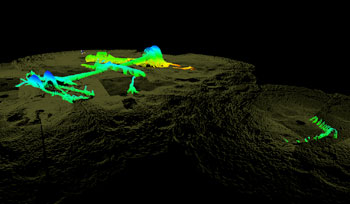
sonar of Hatteras
A three dimensional sonar image of the remains of
USS Hatteras (NOAA picture)
The Hatteras wreck site is currently under Federal protection and has been the subject of groundbreaking court decisions.  In Hatteras Inc. v. USS Hatteras, Federal courts ruled that salvages can not claim U.S. Navy, Confederate States Navy, or any other government ship in American waters, simply on the fact that government authorities have not made an attempt to salvage the ship.  The opinion has led Congress to pass several laws, namely the Sunken Military Craft Act, to protect government-owned ship wrecks in American waters.

NOAA has since surveyed the wreck site with three dimensional sonar, released several images of the wreck site: http://sanctuaries.noaa.gov/news/press/2013/pr011113.html#photo

Friday, January 18, 2013

Counter Offensive at Galveston and the Capture of Harriet Lane


USN map of the 1863 action at Galveston
Confederate offensives took a sharp increase in 1863.  On the western side of the Confederacy, "Prince John" Magruder kicked things off for the CSA with a New Year's Day assault on Union forces in Galveston, Texas.   Union forces captured the port of Galveston in October 1862, effectively blockading much of Texas.  When Margruder arrived from Virginia to command ground forces in Texas, he found all ports except Brownsville under the control of Union forces.  He set out to change that. Working with Texas cavalry and local steamboat captains, Magruder converted the steamers Bayou City and Neptune into makeshift gunboats protected by cotton bales.

Patrolling off the coast of Galveston was a squadron of six U.S. Navy ships: USS Westfield, Clifton, Owasco, Sachem, the sailing yacht Coruphues, and the former Revenue Cuter paddle steamer Harriet Lane.  In addition, 260 soldiers from the 42nd Massachusetts Volunteers occupied the wharf. 

Watches aboard Clifton and Westfield spotted Neptune and Bayou City in the moon light at 1:30 a.m., but discounted them as harmless civilian steamers. Soon after, pickets lines of the 42nd began passing back reports of Confederate artillery advancing on the wharf.  Confederate ground forces launched their assault on the wharf at 3 a.m.  Though they had no artillery attached to their unit, the 42nd had the Sachem and Corypheus backing them up with light Parrot rifles. 

Capture of USS Harriet Lane
An hour later, Neptune and Bayou City made their advance on Galveston and Harriet Lane turned to engage the two ships.  A newspaper later reported that someone on shore called out to Bayou City's captain during the advance to give them a "New Year's present."  The captain replied, "Well, here goes your New Year's present!" and pulled the lanyard on his ship's 32-pounder.  The gun exploded in the face of the captain, killing him instantly. 

Neptune then rammed Harriet Lane.  Lane returned fire on Neptune, causing Neptune to take on water and eventually sink.  Bayou City also rammed Harriet Lane and sent boarders to storm the Union vessel.  With revolvers in hand, Harriet Lane's commanding officer, Commander J.M. Wainwright, fought the boarders until he was shot in the head.  The rest of Lane's company soon surrendered after that.

Scuttling of USS Westfield

The rest of the U.S. squadron was a confused mess.  Westfield ran aground amidst the confusion.  Owasco also ran aground, but attempted to sink the now captured Harriet Lane with gunfire.  Corypheus' company came under a hail of musket fire from shore, doing all they could to keep their heads down while they sailed out; Clifton went to help Westfield, then turned around to help Harriet Lane.  But, by this point Harriet Lane had a white flag of truce flying above her.  Instead of trying to recapture Lane or destroy her, Clifton's commanding officer accepted the truce. 

Westfield's commanding officer saw what he believed were more Confederate warships.  He lost his nerve and ordered the ship to be scuttled.  All of the men of the 42nd Massachusetts were killed or captured when Confederate forces overran their positions.  The Confederate ground forces also captured two coal barks.   Clifton became the senior ship in the squadron.  Her commanding officer ordered the remaining Union ships to withdraw to New Orleans.

Admiral Farragut was naturally furious at the loss.  He had Clifton's commanding officer brought up on charges for ordering the withdrawal and failing to recapture Harriet Lane.  The decisive victory led Magruder to proclaim the blockade lifted.  The USS Brooklyn arrived a few days later to put the blockade back in place.

 Read Farragut's official report to Secretary Welles here.

Sunday, January 13, 2013

CSS Florida Escapes Out of Mobile Bay

CSS Florida during the height of her career. Image source: US Navy History and Heritage Command

After being partially outfitted in the Bahamas, the Confederate raider CSS Florida (a.k.a., “Oreto”) made a bold and audacious dash into Mobile Bay in September 1862 (post by Gordon in Sept. 2012). A large portion of the crew, including commander John Newland Maffitt, were stricken with yellow fever. Maffitt was so weak from the sickness he had to be lashed up to keep upright to direct the ship. After receiving a hero’s welcome in Mobile Bay, a two-week quarantine period had to be enforced before the ship could sail up to the docks at Mobile for repair and refitting. During this time in Mobile, Maffitt recruited additional officers, engineers, and crewmen to give his vessel a full complement.

By January 1863, Florida was ready to begin her predatory career. Seven USN gunboats patrolled the mouth of Mobile Bay (USS Susquehanna, Oneida, R. R. Cuyler, Pembina, Aroostook, Kennebec, and Pinola). Early on the morning of 16 January, Maffitt made his move. Under cover of heavy mists (but with strong winds blowing), he slipped by five blockaders (literally duplicating his trip into the Bay, when he evaded two out of 3 gunboats) before he was sighted. The officer commanding the Union blockaders, Commodore R. B Hitchcock, issued specific orders regarding signals to be used if the raider was sighted, and which ships should give chase, but the various ship captains’ reports in the ORN suggest that some confusion reigned as the Florida ran through the blockading vessels (some were not even sure it was the Florida making a run for it).

Maffitt ordered all sail set, and Florida made 14 knots in the gale-force winds under a full spread of canvas and her engines at full speed ahead. The blockader USS Cuyler pursued Florida all that day. During this chase, Florida also slipped by several other outside blockade vessels, one believed to be the sloop USS Brooklyn (close enough that a broadside from the Union ship could have blown Florida out of the water), along with “a large armed ship” and a “fast gunboat”. Maffitt believed he was mistaken by these for one of their own gunboats. The chase continued into the evening. Realizing that his new, white sails showed up well in the dark, giving the pursuing gunboat an easy target to track, the wily officer in grey ordered all sails in and stopped engines. The ship drifted off with the wind and heavy seas in the dark and became “invisible” to the pursuing Cuyler, who continued after what they thought was the raider. After confirming that he eluded his pursuer, Maffitt headed south. The morning of 17 January dawned sunny and clear. Lookouts in the tops reported “Nothing in sight but sky and water.” The Florida had once again slipped the blockade and embarrassed the US Navy.

The “Official Records” of the Navies are an immense treasure trove of facts and information on actions of the Union and Confederate navies during the CW. That said, they can be pretty dry and not exactly compelling reading. However, if you look carefully, occasionally a real gem pops up: in one of his reports to Commodore Hitchcock after the “Florida incident,” Cdr. George F. Emmons of the Cuyler noted laconically “From fancying myself near promotion in the morning, I gradually dwindled down to a court of enquiry at dark, when I lost sight of the enemy.” How much better can it be said??

Many thanks to Gordon for providing a link to “The Life and Services of John Newland Maffitt” on Googlebooks. Published by Maffit's widow, it includes extensive excerpts from his letters, reports, and diary from throughout his career, and was a wealth of information for this post.

Saturday, January 5, 2013

Defensive preparations at Mobile Bay

Water batteries on Mobile Bay. Source: State of Alabama photo archives.

In prior posts, I introduced you to the port of Mobile, Alabama and its importance to the Confederacy (18 Feb 2012 and 25 May 2012). Based on a visit to the City of Mobile in October 1862 and his inspection of the defenses, Gov. John G. Shorter of Alabama wrote to CSA President Jefferson Davis, observing “(Mobile is) the only Gulf port of any importance which is left us and one of the most important lines of communication in the Confederacy.” Davis’ response indicated he did not think there was any immediate threat to Mobile, plus he did not have any spare troops to send.

In Mobile Bay and the navigation channels leading into it, work proceeded to try to make it difficult for Union gunboats to get through. Part of the strategy was to slow them up enough to enable the big guns of Forts Morgan and Gaines to pound them and drive them off or sink them. Much of the defensive effort was conducted under the supervision of Major Danville Leadbetter of the CS Army Engineers. Work began in 1862 on Ft. Grant, in Grant’s Pass, to deny a Union expedition through the “back door” into Mobile Bay via the sounds of the Mississippi coast. Rows and rows of piles were driven into navigation channels leading into Mobile Bay to punch holes in the wooden hulls of Union gunboats. A large, heavy chain supported by rafts was proposed to block the main channel into Mobile Bay near Ft. Morgan. In addition to the armament in the masonry forts, earthworks and batteries were emplaced around the forts to repel any land assaults on them.

By mid-1863, the first torpedoes arrived to begin a program of extensive mining of the entrance channels, leaving only narrow gaps through the mines that the pilots of blockade runners knew about. These were placed under the direction of CSA Major Gen. Dabney H. Maury, who had seen their effectiveness against Union gunboats on the Mississippi River. Under the command of Adm. Franklin Buchanan, floating batteries, two of which were ironclad (CSS Huntsville and Tuscaloosa) were placed to support land-based defensive works. Floating batteries and earthworks were also constructed on the river approaches to deter movements by the USN on the rivers. Efforts to make the masonry forts more resistant to USN shelling involved construction of sand/sod embankments in front of the masonry walls and attaching cribs (wood boxes) filled with sand to detonate shells and prevent their penetration of the brick masonry.

Confederate torpedoes placed in Mobile Bay. Source: Harper's Weekly (courtesy www.sonofthesouth.com)

Friday, October 5, 2012

War on the Periphery-U.S. Naval Forces Capture Galveston, Texas

The port of Galveston, Texas represented the far western edge of Civil War Naval activity.  Before the war, the port did brisk business in the coastal cotton trade.  Dominated by the Morgan Lines shipping company, the port hosted upwards of 600 small ships a year, taking Texas cotton to New Orleans and bringing back manufactured goods. 

USRC Harriet Lane
When the war started, the U.S. Navy would occasionally send over one or two warships to blockade the port.  The presence of the ships caused anxiety among the locals that the city's defenses were inadequate.  They feared they would have to surrender without a fight if Union forces attacked.  Many Southern newspaper writers attempted to downplay local anxiety. Channelling the future Winston Churchill, one local writer stated, "That this city and island of Galveston will in case of an attack by an enemy, that every foot of soil will be contested, every acre of channel and harbor be struggled for, while over a hundred thousand can be rallied.  Galveston shall survive the shock and a monument to Texas valor."

On October 4, 1862, the local Confederate commander Colonel John J. Cook noticed eight ships off the coast of Galveston.  The ships were: USS Owasco, Westfield, Clifton, USRC Harriet Lane, and a few mortar schooners.  At 7 a.m., Harriet Lane approached the city under a flag of truce.  There was a delay in the Confederate response.  Namely, Cook could not find a suitable boat,which led to nervous Confederate gunners to open fire with older 24-pounder cannons at Harriett Lane.   Gunners on Owasco replied with a shell from the ship's XI-inch Dahlgren which bursted over the Confederate garrison.  The garrison quickly withdrew. 
USS Owasco

At 3:30 p.m., Commander William Renshaw, commanding officer of the U.S. Navy eight ship flotilla finally  got his formal demand of surrender delivered to Cook.  The colonel replied that he would surrender the city, but needed four days to evacuate.  Cook planned to not only withdraw all military units from the city, but all civilians as well.  Renshaw agreed.

After the evacuation was complete, Renshaw took over Galveston.  He informed Admiral Farragut that he needed more ground forces if the Union were to hold on to the port.  Farragut agreed in principle, but concluded that the Army would never provide the necessary resources.  As for the Confederates, Cook did not withdraw far.  His forces only went as far as Virginia Point on the other side of Galveston Bay.  Here, a garrison of 3,000 men took up positions.   

Saturday, February 18, 2012

Mobile in the Confederacy

Images of Mobile, Alabama. From Harper's Weekly:


After New Orleans, Mobile was the most important port on the Gulf coast for the Confederacy. When New Orleans fell in the spring of 1862, Mobile became the most important port on the Gulf coast.

There were a number of reasons for this port’s value. Mobile Bay was an embayment running in a north-south direction, with a narrow mouth at the south end, guarded by Forts Morgan and Gaines (which were both under construction at the beginning of the Civil War). The City of Mobile lay at the northern end of the bay. Any naval assault on the city would have to pass through the mouth, run the gauntlet past the forts, and then up the bay to the city. Two major river systems, the Tombigbee and Alabama Rivers, converged at Mobile and provided river access to the interior. Mobile itself had a foundery and ship building facilities, and upriver the City of Selma had additional industrial capability.

In addition, several major railroad lines linked Mobile to other parts of the Confederacy, and provided the main link between the eastern and western portions of the CSA. Mobile’s rail connections proved to be of immense military value to the Confederacy, enabling the movement of troops to critical areas where and when they were needed. Confederate Gen. Braxton Bragg, when he was garrisoning Pensacola, Florida, considered the ability to easily move troops by rail between Mobile and Pensacola, “worth 3,000 men at each end.”

Mobile was among the last major southern cities to fall at the end of the war. Yet, this defeat had no influence on the ultimate outcome of the war, as by 1865 (when the city was taken), the war was already won by the North. If the city has been taken earlier in the war (say, in 1862), historians estimate that this would have ended the war much sooner than it ultimately did. Interestingly, it seems both northern and southern leadership acknowledged the importance of Mobile and Mobile Bay, but both sides did not allocate the military resources to take or defend the city.

Through much of the war, Mobile remained an important port for blockade running, bringing critically needed supplies into the Confederacy and distributing them to where they were needed.

Thursday, September 29, 2011

Ship Island-The Unsinkable Tender

To borrow a modern U.S. Navy term, each of the U.S.N's blockading squadrons needed a "forward deployed" base near the war zone if it had any hopes of keeping ships on their stations for lengthy periods of time. The Gulf Blockading Squadrons' base was Ship Island.

Located about 15 miles south of the mainland of Mississippi, Ship Island had been used for decades before the Civil War as a safe anchorage. The island's value to national security was evident with the construction of Fort Massachusetts in the 1850s (not finished until the end of the war).

The 4th Louisiana occupied the island at the beginning of the war, but it soon became evident that it would difficult for Confederate forces to hold while U.S. Navy ships were the area. Confederate Major-General G.E. Twiggs noted in September 1861 that a squadron of "Two heavy frigates, two steamers, a brig, and two tenders" were bearing down on his garrison. Fearful of being cut off and not waiting for further instructions, he wisely ordered an evacuation.

Union ground forces formally occupied the island a few weeks later. For the rest of the war, Ship Island served as a major repair and resupply base for blockading ships and as a jumping off point for operations all along the Gulf Coast.