Showing posts with label ships. Show all posts

Sunday, December 5, 2010

Those Old Ships of the Line

Hard to believe, but at the eve of a war which would feature use of armored warships, steam propulsion, rifled naval guns, mines, and primitive submarines, the U.S. Navy retained several ships-of-the-line on the vessel list. Although most sat on the stocks out of commission, in 1860 the Navy counted eight 74-gun and two 120-gun ships-of-the-line.

Retention of such seemingly obsolete vessels was not as absurd as it may seem. Steam propulsion, a technology still evolving past infancy, suffered from a few tactical issues. Among those was slow speed handling in exactly the tight formations in which doctrine called for the battle divisions to fight. Yes, just as Army officers looked back to the Napoleonic wars for components of their tactics and doctrine, many naval officers considered Nelson's battle line in regard to dispositions. And certainly around appropriations time, many noted place of honor the ship-of-the-line retained even as steam power prevailed.


(Contemporary Illustration of the USS Pennsylvania - Wikipedia commons)

The USS Pennsylvania, laid down in 1822 and commissioned in 1837, was the largest sailing warship ever built in the United States. Rated as a 120-gun ship, by 1860 she was laid up in Norfolk as a receiving ship. If fitted out for war, the Pennsylvania would mount an impressive mix of 8-inch shell guns and 32-pdr cannon. But she was not ready for war as the secession crisis loomed.

Also laid up at Norfolk were the 74-gun ships USS Columbus and USS Delaware. The Columbus was completed in 1819 and commissioned in 1828, the Delaware actually carried 84 guns. A sister ship of the Delaware, the New York was, according to some sources, laid up incomplete at Norfolk. But the Naval records indicate the partially completed vessels was in the New York shipyard. Regardless the New York was never actually commissioned into the U.S. Navy.

(USS North Carolina - Wikipedia commons)

The USS North Carolina served as a storeship in at the New York Navy Yard. Another 74-gun ship, the USS Ohio which dated to 1820, lay in Boston as a receiving ship. Other ships of the rate - the Alabama, Vermont, and Virginia - lay incomplete and thus not commissioned on the stocks. And at Sacketts Harbor, New York, the New Orleans, a 120-gun rate, remained incomplete as the sole Great Lakes ship-of-the-line.

Of the American ships-of-the-line, the Columbus,, North Carolina, and Delaware saw substantial service before the Civil War. The Columbus and Ohio were active during the Mexican War. Like the American frigates, the American 74s often carried guns in excess of their rate. The North Carolina reportedly carried over 100 guns during some Mediterranean cruises.

As indicated, at the time of South Carolina's secession in December 1860, none of these vessels were ready for service. Faced with other operational concerns, the Navy let the ships remain either on the stocks or in yard support capacities right up to the start of the Civil War. The Navy burned the Pennsylvania and Delaware when Virginia state troops took over Norfolk in April 1861, somewhat symbolically marking the end of the ship-of-the-line era.
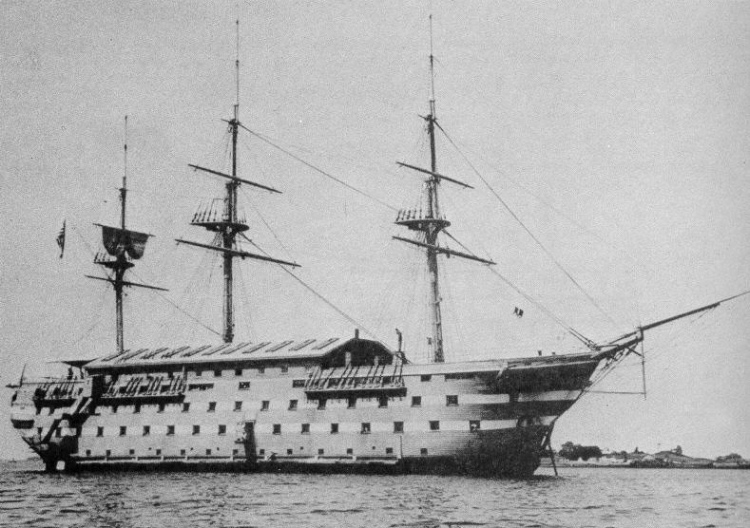

(USS New Hampshire as receiving ship - Wikipedia commons)

However, a few of the big old sailing ships continued to serve as store ships or receiving ships until the end of the Civil War. The Alabama became the USS New Hampshire, and was commissioned as a store ship. The New Hampshire and Vermont served on station at Port Royal, South Carolina, reportedly receiving heavy caliber Parrott rifles.

As the U.S. Navy entered 1861, in spite of their reserve status these ships-of-the-line were proud measures used to compare with foreign navies. However, during the Civil War the Navy found more use for the ship's holds than the big ship's cannons.

Wednesday, September 22, 2010

USS Tyler: A Rather Useful Timberclad

Early in the war, the Army had requirement for light-draft, armed vessels to escort riverboats transporting troops and supplies along the western waterways. In the summer of 1861, the Navy barely had the notion of a production program, much less actual vessels to meet the need. An early example of cross-service coordination, in June 1861 Commander (later Captain) John Rogers consulted with Army officers and purchased three side-wheel steamers for conversion to gunboats. These were the USS Conestoga, Lexington, and Tyler. The trio cost $62,000.

Rogers complained the vessels lacked fittings and arrangements for warship service. After experimenting to find the appropriate thickness, Rogers ordered five-inch thick bulwarks placed around the vessel to provide minimum protection for the crew against small arms. This and other modifications added $41,000 to the total cost of the modified river boats, informally classed as "timberclads."

Originally named A.O. Tyler, the Tyler was the largest of the three, measuring 178 feet long with a 45 foot beam. The modified steamer displaced between 420 to 575 tons, drawing 6 to 7 feet of water. Her two cylinder engine gave a speed of 8 knots.


The Tyler's armament included six 8-inch guns and one 32-pdr initially. And these guns were put to use shortly after the ship's conversion. Part of the Western Flotilla, technically under Army control with Naval officers on board, the Tyler supported reconnaissance operations in the waters around Cairo, Illinois. In one of the earliest contest between Federal and Confederate warships, the Tyler and Lexington exchanged shots with a rebel gunboat off Hickman, Kentucky on September 4. Later in November, under Commander Henry Walke the Tyler supported General U.S. Grant's landings and assault on Belmont, Missouri.

When Grant moved down the Tennessee River in February 1862, the Tyler was among Commodore Andrew Foote's flotilla which reduced Fort Henry. Afterward, while the ironclads moved around to the Cumberland River to support operations against Fort Donelson, the three timberclads continued down the Tennessee to Muscle Shoals, Alabama, clearing the river of rebel shipping.

The high-point of Tyler's wartime career was on April 6-7, 1862. Along with the Lexington, Tyler protected Grant's river flank at Pittsburg Landing in the battle of Shiloh. During the night, the gunboats intermittently shelled Confederate positions, depriving them of much needed rest and reorganization.

Following Shiloh, Tyler along with the other timberclads operated against Confederate positions around Vicksburg. While patrolling the Yazoo River on June 15, 1862 in conjunction with the USS Carondelet and the USS Star of the West, the Tyler came under fire from the CSS Arkansas. With the Carondelet taken out of action and the Star of the West in retreat, the Tyler alone faced the rebel ironclad. The Tyler managed to reach the safety of the main Federal fleet, but was damaged.

For the remainder of the war, Tyler patrolled the lower Mississippi Valley, occasionally engaging rebel batteries. Formally, the ship was not transferred to the Navy until October 1862. In 1863, her armament increased with three 30-pdr Parrotts replacing the 32-pdrs, augmenting the 8-inch guns. Still later four 24-pdrs were added. The ship often carried a 12-pdr howitzer for landing duties. As with most of the Mississippi Squadron, the Navy sold the Tyler at the end of the war.

For all practical purposes the Tyler and her timberclad sisters were limited ersatz warships built in a period of emergency. With many river miles and battles recorded in the logbook, the Tyler turned out a rather useful warship despite this.

Sources:
Official Records of the Union and Confederate Navies in the War of the Rebellion. Volumes 22-24. Washington: Government Printing Office, 1908-1910.

Canney, Donald L. The Old Steam Navy - Volume Two: The Ironclads, 1842-1885. Annapolis: Naval Institute Press, 1993. Pages 36-37.

Silverstone, Paul H. Warships of the Civil War Navies. Annapolis: Naval Institute Press, 1989. Pages 159-160.