Showing posts with label battle of hampton roads. Show all posts

Wednesday, December 31, 2014

There is a (RED) Light That Never Goes Out: Monitor Looks at 152

By Matthew T. Eng
Naval Historical Foundation

We are closing another calendar year on the Civil War Sesquicentennial. It is the last December of the war years. Civil War naval enthusiasts will note the importance of today’s date across the landscape of the social media blogosphere: the 31 December sinking of USS Monitor.

Monitor put to sea under tow from USS Rhode Island on the final days of 1862. A violent storm soon developed off Hatteras, forcing Monitor’s Commanding Officer John P. Bankhead to signal a red lantern to the crew of Rhode Island for help. The lamp hung with the running lights on the turret, the highest point of the vertically challenged vessel. By the time the Monitor survivors arrived safely on board Rhode Island, their beloved ship began to pitch and roll under the strain of the sea. Sailors recall seeing the red light atop of the turret flickering in and out in the distance as they began to break off. By 1:00 AM on 31 December 1862, the red light was underneath the turbulent waves.
“We watched from the deck of the Rhode Island the lonely light upon the Monitor's turret – a hundred times we thought it had gone forever, – a hundred times it reappeared, till at last...it sank and we saw it no more."-       Surgeon Samuel Gilbert Webber (USS Rhode Island)
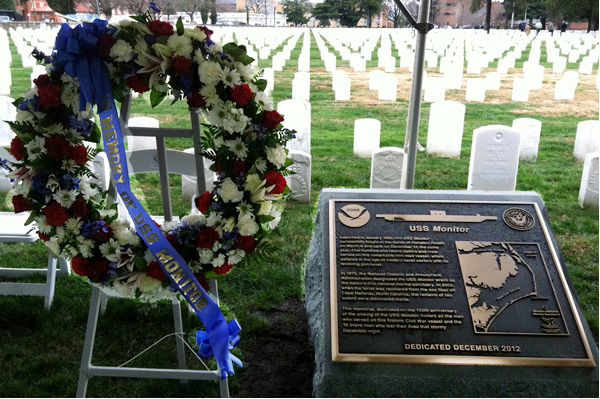
The red lantern and several other important artifacts from the ironclad are back on the surface. Resting underneath the waves are the remains of the ship and the bodies of fourteen sailors. Two of their comrades discovered inside the recovered turret now rest in Arlington National Cemetery.

Such A Heavenly Way to Die?
Significant dates are a tricky form of understanding history, especially in today’s social media-centric society. Anybody can write down or post about WHEN something happened in naval history. Maybe a few historical photos will accompany the brief text. You may “like” it on Facebook. Hell, you may even share it on your wall or tweet it to your followers. But the learning stops there. The dialog dies. We can’t afford to do that when there is so much more to talk about, especially Monitor. It takes talent to convey to others WHY and HOW it happened.


Most stewards of the craft are simply telling you when something happened in the grand timeline of naval history. Fort Fisher falls in January. Mobile Bay was an early August event. The Battle of Hampton Roads is celebrated for two days every March. So much more happens in between a calendar year and a time and place. Merely telling the general public about a significant date in history seems like an empty gesture. The public demands and deserves more. Thanks to a dedicated group of historians, museum specialists, curators, and underwater archaeologists, we continue to learn more about America’s first ironclad every day.

History in the Darkened Underpass
It’s been a tough set of years to mark the current Civil War commemoration. Anyone who tells you differently has not paid close attention to the pulse of the general public. Controversy is a yearly event.

A centennial seems like a nice round number – one that is easily recognizable to the general public. World War I fans are currently reaping the benefits of this in the same way the public honored the recent War of 1812 bicentennial. Looking back at 150 years is more difficult. These years mark the halfway point on the road trip to the bicentennial. It is as if the public is sitting in the back seat of the car, asking leading historians, museum specialists, and authors “are we there yet?” We are there. In fact, there is less than 150 days left in the entire sesquicentennial commemoration. How will it fair during the 175th in 2036?

Monitor was not immune to this harsh criticism in the wake of the Conservation Lab’s closure. The year for Monitor began on 9 January with news from the Washington Post that the USS Monitor lab would close its doors due to a lack of federal funding. The news shocked everyone, in and out of the field. Many of the comments posted on the Post article were anything but helpful. Many questioned why we support such aged history in the first place. Supporters of Monitor soon came to their aid when funding proved short, calling for others to help preserve the lab and artifacts. Thankfully, the lab reopened only a few months later this summer. Monitor was back, and the interest continued to grow.


The Monitor Center Reopens (Adrin Snider / Daily Press)
That interest stayed at this year’s 10th Maritime Heritage Conference in Norfolk, Virginia. A special panel shed light on the recent efforts and partnerships between the Mariners’ Museum, Monitor Conservation Lab, and NOAA. Leading experts on the ship spoke positively about the future of the artifacts. I had a chance to write a nice piece about some of their more recent artifact conversation projects. The sea state was calm. The subject of Monitor and shipwreck history even came up at this year’s World War I Centennial Conference at the MacArthur Memorial. There is so much more to the mystery of Monitor than a single date in time.  

It would seem that the red lantern, which became a central artifact in the discussion of the Monitor’s recovery, is still on. Dave Krop and the fine folks at the lab are still doing the diligent work necessary to preserve one of the Civil War’s most treasured relics.

Monitor is a figurehead of American naval history. One may argue the ship’s supreme importance within the timeline of naval history in general. Monitor is WHY and HOW Civil War naval history is alive and well today. Such an important ship deserves our respect and admiration.


“Well, the pleasure – the privilege is mine” to continue to work with those who would see the red light never extinguished from the memory of Monitor. Thank you to all who keep it lit.  

Tuesday, December 31, 2013

Heroes Get Remembered, but Legends Never Die: The Ongoing Fascination with USS Monitor


Today marks the 151st anniversary of the sinking of the USS Monitor.  It is as much a front story headline over a hundred and fifty years ago as it remains today.  The burial of the two unidentified sailors at Arlington National Cemetery in March hit worldwide popularity among the major news outlets.  It is by far one of the most intriguing stories of the American Civil War.  But why?  

This post is but one of many written about the Monitor today.  That is no secret.  It's an anniversary, after all.  In a block of major commemorations already occurring (WWII, 1812, WWI, Korea), it seems only natural.  Our own American love affair with commemorations continue to drive many history-based blogs and social media outlets such as the CWN 150.  History happens within these parameters.  The job of the historian and the general public is to remember it in whatever way they seem fit: ceremonies, stories, publications, lectures, etc.  It is an unspoken "social contract" Civil War enthusiasts signed back in 2011 at the commemoration's beginning.  The story of the Monitor, however, is still alive and thriving.  Others already faded into the distant sleep of the bicentennial.  


Battlefields around the country also received their attention this year.  Thousands of visitors braved the heat and flocked to the Gettysburg and Vicksburg sesquicentennial commemorations.  Their stories certainly deserve equal praise and reverence.  What is particularly interesting about the USS Monitor, now 151 years later, is its adaptability.  Her story constantly evolves.  Like some creature lost in the evolutionary chain, the men of the Monitor adapt to the changing time periods. 

Dozens of books about the Monitor currently line your book store's Civil War section.  The majority of these published over the course of the last decade.  Timeliness is next to godliness.  Many monographs claim "new developments" or "uncovered history."  This is perhaps an intentional play on the ship's 2002 recovery.  Even after the hoopla of the ship's sesquicentennial anniversary during the Battle of Hampton Roads in 2012, books, articles, and news stories continue to surface.  Far beyond the typical "15 minutes" of historical fame, the Monitor has overstayed its welcome.  We are okay with that.

The continued fascination exists on everything from wine bottles to memorial plaques and challenge coins.  In the grand scheme of collective memory, the Monitor is THE BRAND for the Civil War navies.  At a time when branding takes up so much time and energy for museums and institutions around the world, enthusiasts for this subject have known theirs for years.  Whether you like the publicity or not, the Monitor is here to stay.  

Heroes get remembered.  Legends like the Monitor, however, never die.  That is a promise as ironclad as the ship itself.  

Here's to 151 years.  As you toast your champagne tonight, save a little bit for the Monitor boys.    
    

Wednesday, November 21, 2012

USS Monitor 150th Anniversary Experience at the Mariners' Museum


Auctioned “Experience” Inside USS Monitor’s Revolving Gun Turret to Highlight 150th Anniversary of Ironclad’s Demise, 
Support Ongoing Conservation 

For Immediate Release 

Newport News, VA (Nov. 20, 2012) – The Mariners’ Museum and partners at NOAA’s Monitor National Marine Sanctuary are marking the 150th anniversary of the USS Monitor’s sinking by offering an unprecedented opportunity on December 30, 2012: the chance for six visitors to experience the stories of the ironclad’s final harrowing moments while standing inside the recovered iconic revolving gun turret. 

The Mariners’ Museum and NOAA are auctioning off the chance for six visitors to experience life inside the revolving gun turret Monitor during its final hours on December 30-31. Night-time programming will highlight specific events from the sinking based upon historical documents and personal letters from survivors. Museum staff will also ring Monitor’s original engine room gong to honor sixteen crewmembers that perished during the sinking. The event may also be streamed live via telepresence to other museums that share Monitor’s story. 

“This is the ultimate opportunity to travel back in time and immerse yourself in the final moments of the USS Monitor, arguably the most iconic vessel of the Civil War. The thought of standing inside the 120-ton recovered gun turret with your closest friends, of walking in the footsteps of these Union sailors exactly 150 years later, gives me goose bumps,” said Dave Krop, Director of the USS Monitor Center. “I cannot think of a more unique experience.” 

Lucky winners of the auction will also receive lodging near The Mariners’ Museum, as well as food and entertainment throughout the late evening. 


For more information on this exciting event, please contact Dave Krop at:
(757) 591-7763
dkrop@MarinersMuseum.org 


Monday, May 7, 2012

CSS Virginia's Firestorm


After many unsuccessful attempts to bring Monitor to battle in April 1862, Commodore Josiah Tattnall and CSS Virginia faced a major crisis during the first week of May.   As Union ground forces landed at Ocean View and began to march towards downtown Norfolk and Portsmouth, Confederate ground forces evacuated.  The only problem was that no one in the Confederate Army told Tattnall of the evacuation plan.  His junior officers reported that both the Gosport Navy Yard and the batteries at Sewells Point had been abandoned, and the fort at Craney Island was in the process of being abandoned. 

No stranger to a hard fight (see the "Blood is Thicker Than Water" incident), Tattnall was prepared to make a last stand, but instead elected to move the ironclad up the James River.  He solicited the advice of two local harbor pilots.  Both stated that if Virginia's draft was lightened to draw only 18 feet of water (as opposite to her normal 22 feet), the ironclad could make it to safety near City Point.  The commodore went with the plan and had all the guns and stores removed.  On May 10, 1862, Tattnall was ready to make the attempt.  The pilots, however, changed their mind and informed Tattnall that the attempt could not be made.   John Taylor Wood would later remark "Moral: All officers should learn to do their own piloting."

Knowing the Union forces were closing in, and with great reluctance, Tattnall ordered Virginia to be put to the torch.  Virginia's executive officer, ap Roger Jones, did the honors and set the ship on fire.  The ship's company marched to Suffolk and boarded a train for Richmond where they would live to fight another day.

The veteran flag officer knew the move would be controversial and fully expected to be grilled by his superiors, but not second-guessed.  Three of the Confederate Navy's senior officers and Tattnall's personal colleagues, French Forrest, Duncan Ingraham, and William Lynch, blasted the commodore for incompetence and accused him of being "panic-stricken."  Many officers came to Tattnall's defense and counter-accused the Board for speaking about things they knew nothing about.  Tattnall demanded and received a formal court marital to clear up his name. 

Two months later, a board of twelve officers including Franklin Buchanan, Syndey Lee, and Mathew Murray heard three charges against Tattnall.  After listening to Tattnall's account of the scuttling and the dire situation in Hampton Roads, the court unanimously cleared the commodore of incompetence.  Tattnall was allowed to continue his new command in Georgia. 

A more complete record of both hearings can be found here in a biography of Tattnall (chapter 15). 

Sunday, April 15, 2012

The First Year in Review

Civil War Navy and Marine Reenactors at Portsmouth Navy Birthday (October 2011)
 "Nor must Uncle Sam's web-feet be forgotten. At all the watery margins they have been present. Not only on the deep sea, the broad bay, and the rapid river, but also up the narrow muddy bayou, and wherever the ground was a little damp, they have been, and made their tracks." - Abraham Lincoln (1863)

This past Thursday (12 April) marked the end of the first year of the sesquicentennial commemoration.  What a wonderful year it has been for the Civil War Sesquicentennial and the Civil War Navy Sesquicentennial!

It's been a busy year for the CWN 150 and the blog.  During the first year (12 April 2011-12 April 2012), CWN bloggers wrote 148 individual posts, reaching thousands of new and returning visitors.  The greatest benefit of doing the blog is getting the positive feedback from readers, especially those in those partnerships we have made in the past year like the National Park Service and the Civil War Monitor.
USS Cumberland Expedition (June 2011)
In between that time, the CWN 150 was involved in several events in and around the Hampton Roads area.  In October, the CWN 150 set up an informational table at the annual Navy Birthday celebration at the Portsmouth Naval Hospital in Portsmouth, VA.  Our first "series" of commemorative posts was conducted last year for the 150th anniversary of Port Royal.  Stay tuned for more special posts in the near future!

Several lectures and talks were given by CWN 150/HRNM staffers Matthew Eng and Gordon Calhoun, focusing on the role of the Civil War Navy in public memory and the vital role played by the USS Cumberland during the Battle of Hampton Roads.  The most important lecture series during 2011 was the Civil War at Sea Conference in Washington, D.C.  The CWN 150 was there to hand out hundreds of Civil War Special Edition Daybooks.  Be sure to download a free copy today!  We also were consultants for a 5 part series of videos created by Bob Rositzke about the Civil War navies titled the "Civil War Sea."  If you haven't already, take a half an hour to watch the entire thing on Youtube. 

HRNM/CWN 150 booth at BOHR Weekend at Mariners' Museum (March 2012)
By far the biggest event that occurred this past year was the Battle of Hampton Roads Weekend/Civil War Navy Conference in conjunction with the Mariners' Museum and the Museum of the Confederacy.  The My Hayley lecture at HRNM at the opening night of the commemoration was a huge success, much to the credit of Dr. Hayley and her wonderful book, The Treason of Mary Louvestre.  CWN 150 bloggers and Hampton Roads Naval Museum staff manned the CWN 150 table as well as spoke at several different panels.  Judging by the number of participants that were at the entire weekend of events, it will be hard to top.  Only time will tell!  The more you get the awareness out there, the better these events we have coming up (New Orleans, Hatteras, Drewry's Bluff) will be. 

Thank you especially to fellow CWN 150 bloggers (and ALL out-of-towners) Craig Swain, Seaman Rob, and Sarah Adler for making it to the anniversary.  I think we all had a fantastic time, learned a lot, and made some fantastic connections.  

On the horizon for the CWN 150:
  • Commemorative posts on New Orleans, Drewry's Bluff, and the river war in the West
  • More LEGO ship model designs courtesy of HRNM's "Brick by Brick: LEGO Shipbuilding" Program
  • More trivia contests and ways to get involved
  • Stay posted to the blog, Facebook, and Twitter for the latest updates!
As always, we are looking forward to the remaining sesquicentennial years.

Full Speed Ahead!

Wednesday, March 21, 2012

Hampton Roads is Over, Now What?

 Okay.  So the Battle of Hampton Roads Weekend is over.  It was a great series of events.  Now that its over, let's do a little deductive reasoning:
  • The Battle of Hampton Roads is likely to become the biggest event for the Civil War Navy Sesquicentennial
  • The CWN 150 prides itself at being the one stop source for the flow of information, events, and activities surrounding the Civil War Navy Sesquicentennial.
Drawing back from my scarce knowledge of If-Then statements, one might assume that the Sesquicentennial as a whole is over.  No more huge events that could rival that of Gettysburg, Antietam, Vicksburg, etc. 

WRONG. It's 2012 and we are just getting warmed up!

For one, there is an upcoming Flags Over Hatteras conference coming up in the Outer Banks.  Will you be there?  I would also be remiss if I didn't mention one last post about the weekend from Laura June Davis, contributing editor for The Monitor.   She had some very nice things to say about the weekend and the CWN 150.  Thank you again, Laura. 

So, what is on the radar for the CWN 150, you ask?  Here is a little taste:

More LEGOs:
That's right.  Back from popular demand from the Brick by Brick: LEGO Shipbuilding program at HRNM, we are going to be offering FREE designs for several more Civil War ships (including the CSS Virginia in the very near future).  All designs will be located on the Hampton Roads Naval Museum website, the HQ for the CWN 150. 

More Posts, More Information:
We want to ensure that you are coming to the CWN 150 blog for the best possible information available on the events, activities, and information surrounding the sesquicentennial.  That being said, we will continue providing readers with timely posts on commemorative events and aspects of the navies during the Civil War.  

More contests, more prizes:
I think the title says it all.  More fan-focused contests and ways to get YOU involved in the CWN 150.  Win cool prizes for participating and joining in on the conversation!

More Videos:
If you haven't noticed, our Youtube page is rather lacking.  I would like to rectify that with some more videos for the CWN 150.  These will include educational pieces as well as some commentary on the CWN 150 and its relevance in an ever-increasing social media world. 

Want to be part of the CWN 150? "Enlist" your blogging talents!
We are still looking for more writers for the CWN 150!  If you have an interest in social media or blogging about the Civil War navies, please send an email to matthew.t.eng@navy.mil for more information.  This commemoration is for everybody, so why not get everybody involved!  Like us on Facebook, follow our Twitter feed, or just keep reading.  Have an idea for the CWN 150?  Don't be afraid to email us with a message.  You might be surprised what happens! 

To take from the famous poster you see all over the place:


- Matthew T. Eng

Friday, March 16, 2012

In Case You Missed It: Watercolor Contest Winners!

Over the past weekend, there was a lot of interest generated about the Battle of Hampton Roads Watercolor Contest.  For its first time around, it was a great success.  I hope everyone that saw the original art on the evening of 8 March enjoyed it as much as we did.  In case you didn't get to see the art on the 8th or are not a fan of either the CWN 150 or Hampton Roads Naval Museum on Facebook (and you SHOULD BE!), here is the link to the HRNM Facebook site with ALL of the participants scanned in for your viewing pleasure.  We have reproduced the three age group winners below.  With your continued support, the Hampton Roads Naval Museum can make the watercolor contest an annual event!


Olivia Eicher - Age 5-10 Winner
Nathan Cowfer - Age 11- 13 Winner
Sarah Howland - Age Adult Winner

Tuesday, March 13, 2012

Battle of Hampton Roads Weekend Recap

CWN 150 Bloggers Unite! (Matthew Eng, Sarah Adler, Craig Swain, Seaman Rob)

Although we have already posted several posts on this past weekend's Battle of Hampton Roads festivities, I would be hard pressed if I didn't say a few words to wrap up the fantastic event.
NHHC Director Jay Deloach at Descendant's Breakfast
From start to finish, the Battle of Hampton Roads Weekend (March 8-11) was a success.  Beginning with My Hayley's talk on the Treason of Mary Louvestre and ending with the final talk I had the pleasure to give with Anna Holloway on the Civil War in Public Memory, the event was marvelous.  Everything in between: the descendant's breakfast, the reenactors, the living history day crafts and activities - all of it was fantastic.

Unveiling of Monitor Facial Reconstruction


Above all, I was most impressed with the interest from visitors coming to visit the HRNM booth.  It warms my heart to see the hard work put into this commemoration is paying off - either for this commemoration, museums like HRNM and the Mariners', or for enthusiastic individuals who do amazing work online and in print like Craig Swain and Laura June Davis. 

The talks I attended were great.  To be honest, the Hampton Roads Naval Museum booth was swamped.  The only talks that I went to were Dr. Holzer's great discussion of Civil War art on Friday night and the ones HRNM staff presented at.  Either way, fellow blogger Seaman Rob can fill you in with that information from previous posts.


Laura Orr talks with visitors

I want to personally thank Anna Holloway for all her kind words this weekend.  The Mariners' Museum has been a wonderful ally and friend in getting the word spread that the Civil War Navy matters.  For new individuals we met this weekend - welcome.  It is a pleasure to meet you.

This commemoration, no matter what somebody might tell you otherwise, is yours.  It is up to YOU the readers and followers of Civil War history to pass the torch and keep the conversation going.  Without your help, the information provided here or other sites set up in commemoration of the war will all be for nothing.  We are all here to provide you with the most up to date information on events and activities surrounding the Civil War Navy Sesquicentennial.  We clearly saw this weekend that the message is out there and you are responding - we had over 800 people come up to our booth (Hampton Roads Naval Museum) and take our literature, admire the Monitor and Virginia LEGOs, and just talk and interact with us. 

So, from the bottom of my heart, I want to thank you for reading this blog and keeping the fire alive.  Let's keep the momentum going.  Tell somebody about the site, talk about Civil War history, visit a maritime/naval museum, or just remember that you were a huge part in the memory of the 150th anniversary just by remaining an active member of the public perception of this country's most trying time.

Full Speed Ahead,
Me, Gideon Welles, and Seaman Rob
Matthew T. Eng
Coordinator
Civil War Navy Sesquicentennial

Thursday, March 8, 2012

The Cumberland by Henry Wadsworth Longfellow

The Cumberland at rest today (NOAA/HRNM/NHHC)
At anchor in Hampton Roads we lay,
On board of the Cumberland, sloop-of-war;
And at times from the fortress across the bay
The alarum of drums swept past,
Or a bugle blast
From the camp on the shore. 
Then far away to the south uprose
A little feather of snow-white smoke,
And we knew that the iron ship of our foes
Was steadily steering its course
To try the force
Of our ribs of oak.

Down upon us heavily runs,
Silent and sullen, the floating fort;
Then comes a puff of smoke from her guns,
And leaps the terrible death,
With fiery breath,
From each open port.

We are not idle, but send her straight
Defiance back in a full broadside!
As hail rebounds from a roof of slate,
Rebounds our heavier hail
From each iron scale
Of the monster's hide.

"Strike your flag!" the rebel cries,
In his arrogant old plantation strain.
"Never!" our gallant Morris replies;
"It is better to sink than to yield!"
And the whole air pealed
With the cheers of our men.

Then, like a kraken huge and black,
She crushed our ribs in her iron grasp!
Down went the Cumberland all a wrack,
With a sudden shudder of death,
And the cannon's breath
For her dying gasp.

Next morn, as the sun rose over the bay,
Still floated our flag at the mainmast head.
Lord, how beautiful was Thy day!
Every waft of the air
Was a whisper of prayer,
Or a dirge for the dead.

Ho! brave hearts that went down in the seas!
Ye are at peace in the troubled stream;
Ho! brave land! with hearts like these,
Thy flag, that is rent in twain,
Shall be one again,
And without a seam!
 

Wednesday, March 7, 2012

More News for the Monitor Faces (and one for Virginia)

EXTRA! EXTRA! READ ALL ABOUT IT! 


We are endeavoring to bring to you the latest and greatest news about the recent release of the two unidentified Monitor sailors as it comes in.  Here are some of the latest links for your reading pleasure.  Stay tuned to hear more about this interesting saga in American naval history as it unfolds here at the Civil War Navy Sesquicentennial. 

Could These Be the Faces of the Monitor?
Daily Press Article online HERE.

Lost At Sea: Do You Know These Civil War Sailors?
Vermont Public Radio broadcast HERE. 

UPS Delivers History to U.S. Navy Memorial
Atlanta Business Chronicle article HERE.

Names and Faces Suggested for Monitor Sailors
National Geographic Article HERE.

Faces of Civil War Sailors to Aid in Search for Their Identities
WBDJ7 Article HERE.

Facial Reconstruction Brings Drowned Civil War Sailors to Life
LiveScience article HERE.

//---------------------------
...and one for the CSS Virginia

The Battle of Hampton Roads: Constructing CSS Virginia
Daily Press Article HERE.


Monday, March 5, 2012

USS Minnesota and the Fate of Andromeda


When Virginia made her ascent of the Elizabeth River and appeared in Hampton Roads on March 8, 1862, the New York Times and many others described her as a “mysterious marine monster.” The print makers Currier & Ives titled their print of Virginia’s scuttling on Craney Island a few weeks later as “The Destruction of the Rebel Monster.” Thus it is quite clear how the Northern public viewed the Confederate ironclad. Under this view, Minnesota played the part of the beautiful maiden Andromeda. In the Greek myth, King Cepheus chained his daughter Andromeda to a rock so that she would be eaten by a monster sent by the god Poseidon and satisfy the ocean god’s wrath.

In the Battle of Hampton Roads, the “monster” had already slain two of the Navy’s old heroes, USS Cumberland and Congress, and now was moving in for his prize. But just as in the Greek myth (and played out in two different versions of the movie Clash of the Titans), the hero Peruses rides into the battle on the back of the winged horse Pegasus, whose part was played by USS Monitor, to save the maiden from being ripped to pieces.

Poet and playwright George Henry Boker’s 1864 epic poem “The Cruise of the Monitor” provided readers with a synthesis of the myth and modern history:

Out of its den [Virginia] burst anew
When the gray mist the sun broke through
Steaming to where in clinging sands
The frigate Minnesota stands
A sturdy foe to overthrow
But in a woeful plight to receive a blow.


But see!
Beneath her bow appears!
A champion no danger fears
A pigmy craft that seems to be
To this new lord who rules the sea
Like David of old to Goliath bold
Youth and giant by Scripture told

Playing the part of Andromeda was an unfortunate and unexpected position Minnesota found herself on that famous day. For years, the ship had been center of national and international attention. The steam frigate was one of the most well designed warships in the world and was a sight to behold. When the Navy commissioned her and her sister frigates of the Merrimack-class in the 1850s, European navies felt threatened by American warships for the first time since USS Constitution scored her legendary victories during the War of 1812. The Navy recognized Minnesota’s prowess and looks by designating her to be the diplomatic vessel for America's early ambassador to China. The Navy then made her the flag ship of the Atlantic Blockading Squadron early on in the Civil War. But, in the Greek myths, the gods were a fickle bunch, who regularly changed their minds and enjoyed abusing their subjects. Likewise, in a period of 48 hours, Minnesota went from Poseidon’s personal champion to Poseidon’s lunch.

Sunday, March 4, 2012

Monitor Mania!

LSU Faces Laboratory/AP
This upcoming week will mark one of the most excited periods of events for the Sesquicentennial of the American Civil War.  For commemorations focusing on the navies, it is perhaps the most important.

Faces of 2 USS Monitor crewmembers reconstructed

As many readers know, we are in the process of celebrating the 150th anniversary of the Battle of Hampton Roads.  Over the past few weeks, several articles around the country posted news and information on the upcoming anniversary.  The most interesting piece of information coming out this past week was the latest and greatest from the LSU FACES laboratory.  According to the AP writer STEVE SZKOTAK, the latest forensic technology helped to reconstruct the two unidentified faces of the sailors left inside the famous turret when it sank in December 1862.  Unfortunately, DNA testing done from bone samples did not render any living descendants of the two sailors' families.

Perhaps that is all that we will know.

According to an interview with James Delgado, director of NOAA's Maritime Heritage Program, "the faces are really the last opportunity we have, unless somebody pops up out of nowhere and says, 'Hey, I am a descendant.'"  Read the full AP article HERE.

Here are some of the other recent articles on USS Monitor around the internet:

Experts Rebuild Faces of Civil War Sailors - Newser

The Monitor Still Captivates - Washington Post

Clash of the Ironclads - Daily Press

All in all, it is shaping up to be a huge week for the Civil War Navy Sesquicentennial.  If you haven't already, make sure to check out the Battle of Hampton Roads Weekend at the Mariners' Museum.  The CWN 150 will be there.  Will you?

Thursday, February 16, 2012

Upcoming HRNM/CWN 150/Mariners' Museum Events for March 2012

The Treason of Mary Louvestre After Hours Event at HRNM
March 8, 2012
6:00 P.M.
 FREE
KICK OFF THE BATTLE OF HAMPTON ROADS WEEKEND AT HRNM!

Join in the commemoration of the 150th anniversary of the Battle of Hampton Roads. Dr. My Haley, widow of author Alex Haley, who helped write the Pulitzer Prize-winning novel Roots, will speak about her new historical novel, The Treason of Mary Louvestre. This book is based on the true story of a former slave-turned-spy who provided detailed information about the CSS Virginia to Navy Secretary Gideon Welles during the American Civil War. In addition to Haley’s talk and book-signing, the Battle of Hampton Roads watercolor contest participants’ art will also be shown during this event.

For more information, please go to the Naval Museum homepage HERE.

2012 Civil War Navy Conference Full Schedule
(CWN 150 Bloggers Highlighted in Red)


Schedule courtesy of the Mariners' Museum and the Battle of Hampton Roads Website.  For more information and conference rates, go to the weekend's website HERE.

Friday, March 9 at 7 p.m.
Award-winning Lincoln scholar Harold Holzer will present Victory Without the Gaud:
The Battle of Hampton Roads and the Transformation of Civil War Art
.

Ferguson Center on the campus of Christopher Newport University
FREE & OPEN TO THE PUBLIC
Saturday, March 10 at 10 a.m.
United States Naval Academy professor and Civil War Naval scholar Craig Symonds will present
The War Along the Atlantic Coast
.
The Mariners' Museum
FREE with museum admission
Sunday, March 11at 10 a.m.
Local Virginia historian and preservationist John Quarstein will present his research for his latest book,
The Monitor Boys: The Crew of the Union's First Ironclad as well as information from his reissued work
CSS
Virginia: Mistress of Hampton Roads.
The Mariners' Museum
FREE with museum admission

Saturday, March 10 Sessions
Search for and Discovery and Identification of the USS Monitor Wreck Aboard the R/V Eastward
Dr. Robert Sheridan, Professor Emeritus, Rutgers University

"Where's the Starboard Beam?"  Commanding the Tin-Can From Inside an Iron Box
Francis DuCoin, Independent Historian & volunteer, USS Monitor Conservation Project

"Iron Coffin: War, Technology, and Experience Aboard the Monitor"
Dr. David Mindell, Professor of Aeronautics and Astronautics, Frances and David Dibner Professor of the
History of Engineering and Manufacturing, Massachusetts Institute of Technology

A Brotherhood Adrift: Confederate Sailors
Laura June Davis, Doctoral Candidate, University of Georgia

"Sink the Merrimac!": Northern Plans, Schemes, and Inventions to Destroy the Rebel RamDr. David Gerleman, Assistant Editor, Papers of Abraham Lincoln Project

Naval Station New York: The Heart of the Union Anaconda
William Whyte, Doctoral Candidate, Lehigh University

Union Combined Operations in the Spring of 1862: An Examination of Leadership and Unity of Effort –
J. Michael Moore, Curator, Lee Hall Mansion

Pumping YOU Up: Conservation and Replication of the Worthington Steam Pumps from the USS Monitor
Will Hoffman, Conservator, The Mariners' Museum

Palmetto Iron: The Construction of the CSS Chicora and CSS Palmetto State, 1862
Charles Wexler, Doctoral Candidate, Auburn University

The Monitor and Beyond: Updates from the Graveyard of the Atlantic
David Alberg, Joe Hoyt, Monitor National Marine

Sunday, March 11 Sessions
USS Monitor: A Historic Ship Completes its Final Voyage
Dr. John Broadwater, NOAA's Monitor National Marine Sanctuary

Hunter Davidson and the CSS Squib
Professor Ed Wiser, Naval War College

USS Cumberland: Latest Findings
Gordon Calhoun, Historian and Editor, Hampton Roads Naval Museum

Civil War Naval History: A Panel Discussion
1. CSS Florida: the Vanishing Ship (Gordon Calhoun)
2. Calling the Union's "Bluff:" U.S. Navy Operations on the James River (Matt Eng)
Matthew Eng, Gordon Calhoun, Hampton Roads Naval Museum

The Monitor’s Unknown Mission: The Appomattox Raid, June 1862
Chuck Veit, President, Navy and Marine Living History Association

Union Sailors and Alcohol
Sarah Adler, Undergraduate, American University

Bad Luck All Around: The North Carolina Built Ironclads
Andrew Duppstadt, NC Division of State Historic Sites; Jim McKee, Historic Interpreter, Brunswick Town/Fort Anderson State Historic Site;
Chris Grimes, Interpreter, The Mariners' Museum

USS Monitor to Dreamland Bell: The Foundry of James Gregory-
David Grider, Architect, New York City

The USS Monitor at 150: Conservation Insights, Observations and Adventures
Conservation Staff, The Mariners' Museum

CSS Shenandoah: Her life, her impact
Sam Craghead, Museum of the Confederacy

Civil War Naval Chaplaincy and Rev. John L. Lenhar
t
Captain Thom Mitton, US Christian Commission

Civil War Public Memory in a Social Media World
Matthew Eng, Deputy Educator, Hampton Roads Naval Museum

Fighting for Their Lives: Theories on what happened when the Monitor went down
Paul Clancy, Virginian Pilot

For more information contact Anna Holloway at aholloway@marinersmuseum.org