Showing posts with label St. Andrews Bay. Show all posts

Monday, February 17, 2014

St. Andrews Bay Salt Works Raids Again

Historic marker in a public park in Panama City describing the salt works raids. Author's photo.

In a post in December (December 2013 post), we called attention to a major Union Navy raid on the Confederate salt works in St. Andrews Bay. Because of the critical importance of salt, the Confederates very quickly rebuilt the salt works in St. Andrews Bay after the Union forces departed. The southerners would not give up!  Escaped slaves told Acting Master W.R. Browne of the bark USS Restless about this, and that additional material was being transported down the Wetappo River to build larger works in the Bay. He sent in two parties of his men to again destroy these works. Browne reported on 17 February 1864:

Learning that the rebels had erected new Government salt works on West Bay, on the site of the old salt works destroyed by us in December, and that they had a force of 50 men armed and stationed there for protection, I fitted out the first cutter, manned with 13 men, under charge of Acting Ensign James J. Russell, with orders to proceed up the Gulf coast 20 miles, and march inland 7 miles to the salt works and attack them in the rear, while Acting Ensign Henry Eason with 10 men, in command of the second cutter, would proceed by the inside passage and attack them in the front at the same time.

The expedition was entirely successful, the works being abandoned upon the appearance of our men, Messrs. Russell’s and Eason’s party joining at the appropriate time, and immediately proceeded in the destruction of everything in the manufactories, consisting of 26 sheet-iron boilers, averaging 881 gallons, and 19 kettles, averaging 200 gallons, making an aggregate of 26,706 gallons, which cost in Montgomery $5.50 per gallon.”

The redoubtable Browne would send in additional raiding parties in March and April 1864. His determination and initiative earned him a promotion to Acting Lieutenant.

Saturday, December 7, 2013

St. Andrews Bay Salt Works Raids 1863


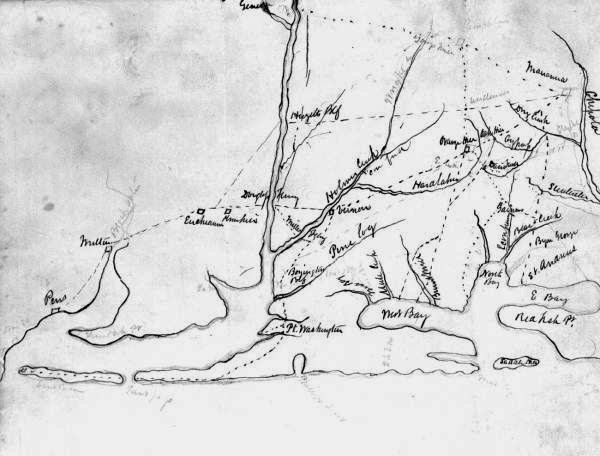
1860's sketch of the Florida coast showing St. Andrews Bay (lower right). Source:  Florida Dept. of State photo archive.

In earlier posts (3 Feb 2012 and 4 Oct 2012) we highlighted the importance of salt to the Confederacy, Florida’s role as a main producer of salt, and the Union Navy’s efforts to destroy salt works along the Florida gulf coast. In his book “Blockaders, Refugees and Contrabands. Civil War on Florida’s Gulf Coast”, George Buker notes that the initial salt works raids were harassing efforts, conducted incidental to other blockade activities. The strategic importance of salt to the Confederacy was not apparent to the East Gulf Squadron command until they noted that nearly every blockade runner captured contained salt as at least a portion of its cargo. It was then that the squadron command realized that a concentrated effort to find and destroy these works would be a major strategic blow to the Confederate war effort. In December 1863 these focused raids began, concentrating on the epicenter of Florida salt production, St. Andrews Bay.

On 2 December 1863 the bark USS Restless, Acting Master William R. Browne commanding, sent a landing party in to Lake Ocala in St. Andrews Bay. They found three separate works with a total capacity of 130 bushels per day. The landing party destroyed carts and flat boats, disposed of the salt, and took 17 prisoners, whom they released because they didn’t have room to bring them back to the gunboat. They made the southerners swear an oath of allegiance to not take up arms against the Union.

Hearing of Browne’s exploits, Acting Ensign Edwin Crissey, commanding the steam gunboat USS Bloomer, sought out the Restless and offered to assist Browne and his ship. Crissey and his ships were actually with the West Gulf Blockading Squadron, but his proximity to the East Gulf Squadron’s operations area enabled him to help there. On 10 December 1863, the USN flotilla entered St. Andrews Bay and split up into two enterprises. Browne fired two shells into the town of St. Andrew (present-day Panama City) to warn the Confederate soldiers and salt workers garrisoned there. He then commenced shelling the town, which shortly was burning. The entire town was destroyed by the fire.

Crissey and his men landed in West Bay and proceeded to the salt works there. From his report dated 20 December 1863 he described a major raid on these:

 At 5 p.m. I proceeded to the salt works on West Bay, destroying the salt works lined on each side of the bay for 7 miles, belonging to private individuals, numbering at least 198 different works, each averaging two boilers and ten kettles each, which, with a large quantity of salt, were destroyed. . . . . On the afternoon of the 14th we came to a large Confederate Government works, under the command of Mr. Clendening, which turned out daily 400 bushels of salt. This was one of the best located in West Bay, being situated in a marsh, the water of which yielded 75 gallons of salt to 100 gallons of water; it was, in fact, a complete salt village, covering a space of three-fourths of a square mile, employing many hands and 16 ox and mule teams constantly to haul salt to Eufola Sound [Eufaula, Ala?], and from thence conveyed to Montgomery, at which place it is selling at a fabulous price of $40 and $45 per bushel. At this place were 27 buildings, 22 large steam boilers, and 200 kettles, averaging 200 gallons each, which cost the Government $5 per gallon, all of which were totally destroyed, together with storehouses containing salt, etc. This work, together with the other works, could not have cost less than three million dollars.”

Notable from this report is Crissey’s description of one of these works as “a complete salt village” and his estimate of the total value of the works he destroyed, on the order of $3 million. In today’s dollars that would certainly translate into tens of millions.

An 1886 Navigation Chart of St. Andrews Bay is on the NOAA historical maps site at:
http://historicalcharts.noaa.gov/tile /zoomifypreview.html?zoomifyImagePath=LC00184_12_1886 . A living history event, the St. Andrews Bay Salt Works Raid, is held in April in Panama City to educate folks about these Union Navy raids and the importance of salt to the Confederacy.

Replica salt kettle at a park in Panama City, FL commemorating salt production during the Civil War.

Sunday, March 17, 2013

Tragic Assault on St. Andrews Bay 20 March 1863


On 20 March 1863, a landing party from the USS Roebuck landed on St. Andrews Bay, near present-day Panama City. Their objective was to attempt to cut out a potential blockade runner.  Acting Master John Sherrill, commanding the Roebuck, received intelligence that a ship was loading cotton to run the blockade. He sent a ship’s boat with 11 men, under the command of Acting Master James Folger, to proceed up the bay to find and destroy or capture the runner. Unfortunately, the landing party ran into a strong defense by Confederate home guard militia, under the command of Capt. W. J. Robinson of the C.S. Army. Seamen Thomas King and Ralph B. Snow were killed in this action and seven other sailors were injured, including the landing party commander, Act. Master Folger. The ORN reports indicate that some of the injured were "severly injured", so perhaps they died later, accounting for the listing of "six dead" on the historic marker. Capt. Sherrill’s squadron commander, Adm. Theodorus Bailey, did not approve of this action, and believed it to be “ill-advised”.

Sunday, April 22, 2012

St. Andrews Bay Salt Works Raid Event 21-22 April 2012

Salt works kettle/boiler display:

Salt works historic marker:

During the Civil War, St. Andrews Bay, Florida, was an immensely important area of salt production for the Confederacy along the Florida Gulf Coast. The second annual living history event commemorating Union Navy raids on Confederate salt works in St. Andrews Bay was held this weekend (21-22 April). The event is put together by the City of Panama City, the Panama City Historical Society, and the Steam Sloop Pawnee Marine Guard (a member organization of the CWN150 Blog). Participating organizations include the Port Columbus National Museum of Civil War Naval History, the USS Fort Henry Living History Association (both member organizations of the CWN150), and the USN Sea Cadet Corps. The event recalls and informs about the importance of salt making to the Confederacy and the Union efforts to disrupt these efforts during the Civil War.

Day 1 (Saturday, 21 April) began fair and cloudy and progressively degenerated into waves of strong rain squalls pushing onshore from the Gulf of Mexico. The day was scrubbed, with some activities in the morning, but no beach landing and assault in the afternoon due to the weather and safety concerns (lightning and strong winds).

Day 2 (Sunday, 22 April) dawned breezy and cloudy, but the sun was out in force by mid-morning. We had a complete day today, doing living history stuff in the morning, and in the afternoon a beach landing of marines and sailors on the Port Columbus Museum’s steam launch. The landing included pyrotechnics planted in the beach (to simulate bombardment from Union gunboats offshore); as we were about to hit the beach they went off, drenching the landing party with sand, detritus and water. Our objective was to destroy a Confederate salt works and withdraw back to our ship. After landing, the marines advanced and set up a defensive perimeter against Confederate home guard. On orders from our landing party officer, I advanced, protected by a contingent of seamen armed with pistol/cutlass and musket, set charges against the main salt works, and after orders from the landing party CO to ignite, we withdrew to the beach and watched the works blow.

I’ll be doing some posts on actions against salt works at St. Andrews Bay later this year as we hit the 150th Anniversary of these events.

US Navy steam launch landing marines and sailors to assault salt works last year (2011). Photo by Paige Creel: