Showing posts with label samuel dupont. Show all posts

Sunday, April 7, 2013

150 Years Ago: The Ironclads Attack Fort Sumter!

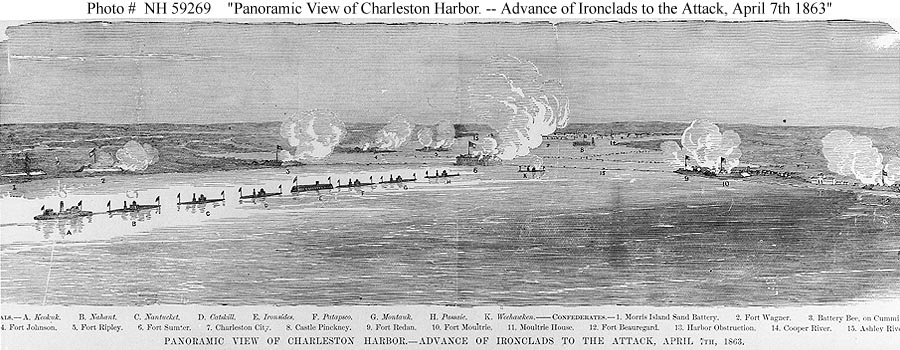
At noon on April 7, 1863, the largest concentration of ironclad warships yet seen in the Civil War prepared for action in the main ship channel leading to Charleston harbor.

The attack which was the culmination of several months of planning, debate, and no small amount of political pressure. One might argue that Charleston, South Carolina was not a significant objective for the northern war effort. But it was a port which had to be blockaded. And more importantly, it was symbolically important as the place where secession first took root. Capturing the city would provide a major boost against war weariness in the north, while dispiriting the south.

The overall plan was for an Army-Navy team to move on Charleston in the spring of 1863. Ironclads assembled at Hilton Head throughout the winter (minus of course the USS Monitor which was lost at sea). By late March, the force included seven monitors, and the the USS New Ironsides and USS Keokuk, of competing ironclad designs. On land, the Army had roughly 25,000 men on the South Carolina coast under Major General David Hunter to cooperate with DuPont's ironclads. Sounded good on paper, but more than a few obstructions lay in the way. DuPont was not confident the ironclads could achieve what was planned. And at the same time Hunter was less than predicable with his support.

The ironclads crossed over the bar into the main ship channel at Charleston on April 5. The force waited on tide, wind, and weather to move at the most opportune hour. DuPont arranged his ironclads into a line ahead - USS Weehawken, USS Passaic, USS Montauk, USS Patapsco, USS New Ironsides (also DuPont's flagship), USS Catskill, USS Nantucket, USS Nahut, and USS Keokuk. The Weehawken carried a "jack boot" raft fixed to the bow as a means of dealing with harbor obstructions and torpedoes known to be in the channel.
 DevilRaft1

 DuPont's orders called for the ships to close within 600 to 800 yards of Fort Sumter before opening fire. The gunners were told to focus on the center embrasure of the fort's northeastern face. The intent was to reduce the fort.
 FortSumterNEFace1
 The term "reduce" indicated DuPont's objective was to not only silence the guns of Fort Sumter, but to render it useless as a defense. By concentrating fires on the center of the wall of the fort which most closely fronted the ship channel, this would ensure follow on, non-armored, ships could more easily pass. The instructions assumed the XV-inch and XI-inch Dahlgrens along with the 150-pdr Parrott rifles of the ironclads could make short work of the brick structure. After all, didn't heavy artillery of this sort breach Fort Pulaski only a year earlier?

The ironclads pulled anchors at around noon. But almost immediately the movement fell behind schedule. The chain of the Weehawken, commanded by Captain John Rodgers, became entangled with the raft on the front of the ship. Not until 2 p.m. did the ships proceed. About an hour later, the Weehawken came under long range fire from the guns of Fort Moultrie. Rodgers reported "The accuracy of the shooting on the part of the rebels was very great, having been attained, no doubt, by practice at range targets, since I remarked that as we passed a buoy all the guns opened at once."

CharlestonIroncladAttack

Rodgers moved the Weehawken close enough to observe the obstructions placed between Fort Sumter and Sullivan's Island. But in the process his ship receive at least 53 hits. A torpedo exploded close to the ship, but caused no damage.

Behind Rodgers, Captain Percival Drayton in the Passaic also moved close enough to observe the obstructions. The Passaic received thirty-five hits including one which disabled the ship's XI-inch gun. One heavy caliber rifled projectile, likely from one of the 7-inch Brookes in Fort Sumter, "struck the upper edge of the turret, broke all eleven plates, and then glancing upward took the pilot house, yet with such force as to make an indentation of 2 ½ inches, extending nearly the whole length of the shot." The sum of damage was so great that Drayton briefly pulled the Passaic out of line.

In the Montauk, Captain John Worden found keeping station against the flood tied while in close proximity to obstructions and other ships to be more dangerous than the Confederate fire. The rebels struck the Montauk fourteen times, "but received no material damage."

The fourth ship in the line, the Patapsco, under Captain Daniel Ammen, opened fire at 1,500 yards on Fort Sumter with its Parrott rifle. Like Worden, Ammen found station keeping difficult while in action. The Parrott rifle was soon out of action due to a broken cap square. Projectiles hitting the turret caused difficulty traversing, so the Patapsco was unable to respond with sustained fires. Forty-seven Confederate projectiles hit the monitor while she lay within 800 to 1000 yards of Fort Sumter.

Commodore Thomas Turner, on the flagship New Ironsides, also faced difficulty working his ship in the channel. Of deeper draft than the others, the New Ironsides was "frequently within a foot of the bottom." Turner's handling of the ship was further complicated by having DuPont and his staff in the turret attempting to fight the battle, while Turner fought his ship. With visibility limited due to the smoke of battle, Turner pulled the ship out of the line and attempted to turn a broadside to the forts. However, he'd stationed the ship directly over a large Confederate torpedo. With perhaps the only luck given to the Federals that day, the torpedo failed to fire due to the length of control cable. But the maneuvering difficulties and the range prevented the New Ironsides from bringing her weight into action. Her broadside fired only once in the engagement.
Captain George W. Rodgers in the Catskill passed the New Ironsides at around 3:30 p.m. and closed on Fort Sumter. Rebel shot struck the Catskill twenty times, one of which buckled some plates. But the monitor gave as good as she got, dismounting one of Fort Sumter's columbiads with a XV-inch shot.

Commander Donald Fairfax on the Nantucket also passed the New Ironsides to close on Fort Sumter. But before long a Confederate shot damaged the XV-inch gun port, and the Nantucket was down to only the XI-inch gun, and even that gun limited to a dozen shots. Although under the rebel guns for only fifty minutes, the Nantucket reported fifty hits.

The Nahaut, under Commander John Downes, likewise came under heavy fire after passing the flagship. Roughly eighty projectiles hit the Nahaut. Damage to the turret prevented the monitor from firing only fifteen times. Not until the next day was the turret freed sufficiently to turn. Some of the battle scars remained on the monitor well into her postwar career - even seen in Spanish-American War photos!

Commander Alexander Rhind commanded Keokuk, last in line of battle. Finding the channel restricted and the monitors positioned so as to prevent clear firing, Rhind moved the Keokuk to the front of the line and dangerously close to Fort Sumter. There the ironclad suffered greatly. Rhind later reported, "The position taken by the Keokuk was maintained for about thirty minutes, during which period she was struck ninety times in the hull and turrets. Nineteen shots pierced her through at and just below the water line. The turrets were pierced in many places, one of the forward port shutters shot away; in short, the vessel was completely riddled." At 4:10 p.m., Rhind pulled his ship back out of line and sought refuge back down the main ship channel. Although able to anchor that evening, clearly the Keokuk was not able to make port for repairs. Early the next morning the Keokuk sank in shallow waters off Morris Island. (Which opens the storyline for another great story.)

At 4:30 p.m., DuPont signaled the monitors to withdraw from action. The Confederates would report the action continued for another hour as they fired on the withdrawing ships. At sunset, the remaining ironclads were out of range at anchor far to the south in the ship channel.

DuPont's ironclads fired just 139 times during the engagement, while the seventy-eight Confederate guns replied 2,229 times. The Federals hit Fort Sumter fifty-five times, inflicting limited damage. But with all those projectiles flying about, casualties were surprisingly light. Only one killed and twenty-one wounded. On the other side, most of the thirteen Confederate casualties were due to an accident with an ammunition chest.

By some predictions, April 7, 1863 should have proven a turning point in military history with a demonstration of the superiority of ironclad, steam-powered warships on seacoast fortifications. Instead, the lessons of Drewry's Bluff and Fort McAllister went unheeded. One non-battle casualty of the failure was the career of Admiral DuPont. In July, Rear-Admiral John Dahlgren replaced DuPont. And DuPont went on mount a vocal campaign to counter the official navy story of the action.

Charleston would not be taken by a coup de main or in a rush by naval forces. Instead the city would be the focus of protracted siege operations that even brought the war into the streets of Charleston.

Sources:
OR, Series I, Volume 14, Serial 20 – Official Confederate reports of the action are in pages 240-78.

Dispatches and correspondence appear in pages 880-90. Report of the torpedoes is on pages 948-52.
ORN, Series I, Volume 14, pages 3-112.
Browning, Robert M. Success is All That Was Expected. Washington, D.C.: Brassey’s Inc., 2002.

Burton, E. Milby. The Siege of Charleston, 1861-1865. Columbia, South Carolina: University of South Carolina Press, 1970.

Wednesday, January 30, 2013

Confederate ambush and capture of the USS Isaac Smith

One hundred and fifty years ago this afternoon, Acting Lieutenant Francis S. Conover skippered the USS Isaac Smith up the Stono River outside Charleston, South Carolina.  The Smith was among the many vessels acquired by the Navy early in the war to work inside the shallow waterways.  Her armament included a 30-pdr Parrott rifle and eight 8-inch Dahlgren guns - rather formidable for 450 ton vessel.  Conover's mission entailed what had become a routine survey of the river, while looking for any new Confederate activity.  Little did Conover know, the Confederates had been very active along the Stono.

In late January, General P.G.T. Beauregard approved a plan forwarded by Brigadier General Roswell Ripley to setup an ambush of Federal gunboats operating on the Stono.  Ripley would wait until the gunboat passed up the channel.  Then using concealed batteries Ripley's men would open up a cross fire to surprise and disable the Federal ship.  Beauregard allocated five rifled 24-pdr guns from the district's siege train.  On John's Island, Major J. Welsman Brown, from the 2nd South Carolina Artillery, commanded two rifled guns.  On the opposite bank, Captain John Gary, 15th South Carolina Heavy Artillery directed three guns near Thomas Grimball's plantation.  So as the Smith made its way around the bends of the Stono, it fell into a trap.


In his report of the action, Conover wrote:

About 3 p.m. of that day I got underway form my usual anchorage in Stono Inlet, with orders from Lieutenant-Commander [George] Bacon, of the USS Commodore McDonough, to proceed up Stono River for the purpose of reconnoitering, as we were constantly in the habit of doing.  A little after 4 I anchored opposite what was known as Tom Grimball's plantation, about 4½ miles from the inlet, and although the signal quartermaster was at the masthead as usual, as well as one or two of the officers, nothing suspicious was seen in any direction.  

From his perspective Gary observed:

Between the hours of 3 and 4 o'clock on the afternoon of the 30th ultimo the gunboat Isaac Smith made her appearance and anchored off Mr. Thomas Grimball's, some 500 yards distant from my batteries.  After waiting some twenty minutes and the Abolitionists showing no disposition to land I ordered my batteries to open fire, which they did in handsome style and apparently with great precision.

 On the receiving end, Conover reacted:

While at anchor, and at 4:25 p.m., a battery upon James Island, of three 24-pounder rifled guns, some 600 yards distant, and masked by a thick clump of trees, opened upon us.  I immediately got underway and cleared for action, and in less than two minutes after the first gun was fired at us we were replying.  At the same time, however, other batteries upon John's Island, on the opposite side of the river and below us, delivered their fire.  I saw immediately that we were trapped, and that my only course was to get the vessels below the battery if possible, and fight them with a more even chance of success.  For upward of a mile, on account of a bend in the river, we were obliged to receive the raking fire of between twenty and thirty guns without being able to reply, except occasionally with our pivot.  As soon as our broadside could be brought to bear, we opened upon the enemy with shell and grape, at from 200 to 400 yards distant.  At one time I had hopes of getting by without any serious loss, but a shot in our steam chimney effectually stopped the engine, and with no wind, little tide, and boats riddled with shot, we were left entirely at the mercy of the enemy.

The USS Isaac Smith under fire
 
As the Smith drifted downriver, Brown's guns were about to enter the melee:

In a short time a furious cannonade began up the river, but with what effect I could not see, as the trees obscured the view.  Soon, however, the boat rounded the point into sight, evidently crippled, but keeping up a running fight with the shore batteries above my position on each side of the river.  I was about to order my guns to open upon her when I perceived that she had a white flag flying, in token of her surrender.

Brown held his fire, and prepared a party to receive the surrender.  At nearly the same instant, the McDonough appeared steaming upriver towards the fight.  After exchanging fire with Brown's battery, Commander Bacon saw no opportunity to save the Smith and retired.  Conover reported eight killed and seventeen wounded, including himself.  The Confederates suffered one man mortally wounded.

 The loss of the Smith proved an embarrassment to the South Atlantic Blockading Squadron and Rear Admiral Samuel DuPont.  (And even more embarrassment awaited the Federals the next day in the waters around Charleston.)  The Confederates recovered the Smith and towed her upriver to Fort Pemberton.  Under new owners, the Smith became the CSS Stono.  After service in the Charleston squadron, the Stono was outfitted as a blockade runner with a load of cotton. While attempting a run in June 1863, she wrecked off Sullivan's Island, near Fort Moultrie.  Confederates later burned the wreck when abandoning Charleston at the end of the war.

The site of the ambush and capture of the Smith is near the present day Charleston Executive Airport, along the Stono River.

(Sources for this article include ORN, Series I, Volume 13, pages 560-5 and OR, Series I, Volume 14, Serial 20, pages 199-204.)


Wednesday, November 2, 2011

Storms off the South Carolina coast

The morning of 3 November 1861 off the coast of Port Royal, SC was stormy, both literally and figuratively. The coast was still being brushed by the trailing remnants of a hurricane that had gone by over the past few days (post by Matt on 29 August), and the storm clouds of war were beginning to gather. After weathering the hurricane on their journey south from Hampton Roads, elements of the South Atlantic Blockading Squadron were assembling off Port Royal in preparation to take the anchorage for use as a base of operations. As detailed by Matt in that prior post, the expedition was beat up somewhat by the storm, but managed to make it through with relatively minimal loss of life and ships. The Army suffered the greater loss, in terms of ships carrying equipment and supplies and the failure to make the rendezvous of the small steamers which were to tow the surfboats loaded with soldiers to the beaches. Flag Officer Samuel F. DuPont arrived the afternoon of 3 November in the flagship USS Wabash, and during the day, other warships of the squadron and US Army transports carrying troops under the command of Gen. Thomas W. Sherman rendezvoused with the flagship. During this time they were being watched by Confederate soldiers in Forts Walker and Beauregard and by Flag Officer Josiah Tattnall of the Confederate Navy, with his “mosquito fleet.” The stage was set for the Battle of Port Royal to begin. Illustration source: US Naval History and Heritage Command.

Tuesday, November 1, 2011

Navy Leadership at Port Royal

As described in our previous post, this week we will be highlighting the Battle of Port Royal.  This was an historic event for the United States (Union) Navy, as it was the first major test of the fleet against formidable, shore based defenses (Forts Walker and Beauregard).  Today's post centers around the two commanders responsible for coordinating the naval attack and defense of the port: Samuel Francis Du Pont and Josiah Tattnall.

Union Navy Leadership: Samuel Francis Du Pont

Union forces specifically needed an adequate and well executed naval component in order for the mission to be successful.  This would prove a daunting task for officials in Washington as well as the newly installed South Atlantic Blockading Squadron Commander Samuel Francis Du Pont.  Du Pont knew about blockade strategy already in his naval career, serving on the blockade of California in the twighlight days of the Mexican American War.  The seasoned Flag Officer, who served  in the United States Navy since 1815, took command of the SABC on 18 September 1861.  He would uphold the command until June 1863.  Port Royal would arguably be his greatest test, now in the waning years of his life. 

For the aging Squadron Commander, preparations were anything but slow.  Decisions were made so fast that Du Pont felt officials in Washington, including President Lincoln, were not being realistic to the start date of the expedition (originally in early October).  The burden of leadership indeed weighed on Du Pont.  In coordination with Brig. General Thomas Sherman's 13,000 troops, 77 ships under Du Pont would assemble at Port Royal. 

If all went well, this early engagement would be a hallmark of combined Army/Navy operations utilized by Union forces during the war.       

Confederate Navy Leadership: Josiah Tattnall

For the Confederacy,   Captain Josiah Tattnal would be responsible for the Southern naval defense of Port Royal.  Although Tattnall opposed secession, he nonetheless resigned his U.S. Navy commission and became a senior naval officer for the state navy of Georgia, his home state.  As the war progressed, he soon found himself in command of the Georgia and South Carolina coastline, which included Port Royal.  He would have very little resources to put against the amassed fleets: several converted tugboats and harbor vessels with 2 mounted cannon. 

It would seem that any subsequent defense of Port Royal would have to rely on its hastily built up forts (Walker and Beauregard).  The forts would become the focus of both Union and Confederate forces in the days to come before the attack.

Friday, October 21, 2011

The Port Royal Expedition and the New York Times


America's Armed Forces and the New York Times have not had the best of relationships over the years (see the Pentagon Papers and more recent spat over leaked e-mails from the National Security Agency to the newspaper).  It is possible that the sour relationship began not in the 1960s, but rather the 1860s. 

In September and October 1861, Flag officer Samuel Du Pont began assembling a fleet of warships, transports, and ground troops in Annapolis and Hampton Roads in preparation for a major offensive in South Carolina.  The offensive's goal was take the excellent natural harbor of Port Royal, South Carolina and make it a base for the newly established South Atlantic Blockading Squadron. 

As the engraving illustrates, the fleet was huge (94 ships) and in sight of the southern shore of Hampton Roads where any Confederate solider could see it.  Nonetheless, Du Pont was furious when he saw this headline in the October 23, 1861 edition of the New York Times:


The article printed not only the number of ships in the fleet, but also the names of the ship's commanding officers and the names of regimental commanders.  The fleet cleared Hampton Roads on October 25.  Whether through the article or their own intelligence efforts, Confederate Secretary of War Judah Benjamin telegraphed his generals in South Carolina "the enemy's expedition is heading to South Carolina."

Saturday, March 26, 2011

The Story of the DuPont Circle Fountain


Rear Admiral Samuel Francis DuPont is, of course, one of the most famous naval figures of the Civil War, so it makes sense that the fountain located in DuPont Circle and dedicated to his memory is one of the most famous landmarks in Washington, DC. This fountain, however, was not the first tribute to DuPont that stood in the park.

In 1882, Congress approved a monument to DuPont. The monument would be paid for by the DuPont family, and it was to be placed in what was then called Pacific Circle. Sculptor Launt Thompson took on the task of creating the DuPont statue. The completed bronze rendition of DuPont was dedicated on 20 December 1884.

Anyone who has ever visited DuPont Circle knows that this statue no longer exists in that location. Perhaps some who have visited Wilmington, Delaware have noticed it in that city instead. It was moved to Wilmington in 1920 by the DuPont family.

The fountain that now represents DuPont in Washington, DC is actually a product of the famous sculptor, Daniel Chester French, and architect, Henry Bacon. These men also collaborated on another well-known memorial - the Lincoln Memorial on the National Mall. The fountain includes three allegorical figures, each standing 8.5 feet tall. These figures represent the Wind, the Sea, and the Stars, which together symbolize the life at sea that DuPont and the rest of the Civil War Navy enjoyed.

But why was the statue moved and the fountain constructed in its place? Some credit monument reformers who had grown tired of heroic representations of figures in statue form and advocated for more abstract concepts in the forms of fountains and other non-statues. This is thought to be the only situation in which monument reformers managed to remove a statue from a location in Washington, DC and replace it with their version of a proper monument.

So if you ever find yourself in DuPont Circle, while contemplating DuPont the great naval figure, also contemplate the hubbub caused by the efforts to make him monumental.

Thursday, June 17, 2010

U.S.N. United, One Last Time


This is a picture of a delegation of Japanese government officials and their U.S. Naval escorts at the Washington Navy Yard, 1860. A few years after Commodore Mathew Perry opened Japan to American trade, the two nations signed a formal treaty and exchanged diplomatic credentials for the first time in 1860. The U.S. Navy escorted the Japanese delegation from Japan to San Fransisco on Kanrin Maru with the steamer USS Powhatan and to Washington, D.C. via Panama and Cuba. You can read more about the 150th anniversary of this historic event at the Consulate-General of Japan in New York's website.

To naval historians of the American Civil War, the picture shows just how gut wrenching the war would become as brother officers would have to fight against each other. Half of the officers in this picture would "Go South" less than a year later. Notable officers in this picture are David Dixon Porter (fourth from the left, wearing the straw hat), Samuel DuPont (center, wearing the top hat), and Franklin Buchanan (center, next to DuPont).  A complete listing of the officers can be found at the NHHC's website.