
The attack which was the culmination of several months of planning, debate, and no small amount of political pressure. One might argue that Charleston, South Carolina was not a significant objective for the northern war effort. But it was a port which had to be blockaded. And more importantly, it was symbolically important as the place where secession first took root. Capturing the city would provide a major boost against war weariness in the north, while dispiriting the south.
The overall plan was for an Army-Navy team to move on Charleston in the spring of 1863. Ironclads assembled at Hilton Head throughout the winter (minus of course the USS Monitor which was lost at sea). By late March, the force included seven monitors, and the the USS New Ironsides and USS Keokuk, of competing ironclad designs. On land, the Army had roughly 25,000 men on the South Carolina coast under Major General David Hunter to cooperate with DuPont's ironclads. Sounded good on paper, but more than a few obstructions lay in the way. DuPont was not confident the ironclads could achieve what was planned. And at the same time Hunter was less than predicable with his support.
The ironclads crossed over the bar into the main ship channel at Charleston on April 5. The force waited on tide, wind, and weather to move at the most opportune hour. DuPont arranged his ironclads into a line ahead - USS Weehawken, USS Passaic, USS Montauk, USS Patapsco, USS New Ironsides (also DuPont's flagship), USS Catskill, USS Nantucket, USS Nahut, and USS Keokuk. The Weehawken carried a "jack boot" raft fixed to the bow as a means of dealing with harbor obstructions and torpedoes known to be in the channel.

DuPont's orders called for the ships to close within 600 to 800 yards of Fort Sumter before opening fire. The gunners were told to focus on the center embrasure of the fort's northeastern face. The intent was to reduce the fort.

The term "reduce" indicated DuPont's objective was to not only silence the guns of Fort Sumter, but to render it useless as a defense. By concentrating fires on the center of the wall of the fort which most closely fronted the ship channel, this would ensure follow on, non-armored, ships could more easily pass. The instructions assumed the XV-inch and XI-inch Dahlgrens along with the 150-pdr Parrott rifles of the ironclads could make short work of the brick structure. After all, didn't heavy artillery of this sort breach Fort Pulaski only a year earlier?
The ironclads pulled anchors at around noon. But almost immediately the movement fell behind schedule. The chain of the Weehawken, commanded by Captain John Rodgers, became entangled with the raft on the front of the ship. Not until 2 p.m. did the ships proceed. About an hour later, the Weehawken came under long range fire from the guns of Fort Moultrie. Rodgers reported "The accuracy of the shooting on the part of the rebels was very great, having been attained, no doubt, by practice at range targets, since I remarked that as we passed a buoy all the guns opened at once."

Rodgers moved the Weehawken close enough to observe the obstructions placed between Fort Sumter and Sullivan's Island. But in the process his ship receive at least 53 hits. A torpedo exploded close to the ship, but caused no damage.
Behind Rodgers, Captain Percival Drayton in the Passaic also moved close enough to observe the obstructions. The Passaic received thirty-five hits including one which disabled the ship's XI-inch gun. One heavy caliber rifled projectile, likely from one of the 7-inch Brookes in Fort Sumter, "struck the upper edge of the turret, broke all eleven plates, and then glancing upward took the pilot house, yet with such force as to make an indentation of 2 ½ inches, extending nearly the whole length of the shot." The sum of damage was so great that Drayton briefly pulled the Passaic out of line.
In the Montauk, Captain John Worden found keeping station against the flood tied while in close proximity to obstructions and other ships to be more dangerous than the Confederate fire. The rebels struck the Montauk fourteen times, "but received no material damage."
The fourth ship in the line, the Patapsco, under Captain Daniel Ammen, opened fire at 1,500 yards on Fort Sumter with its Parrott rifle. Like Worden, Ammen found station keeping difficult while in action. The Parrott rifle was soon out of action due to a broken cap square. Projectiles hitting the turret caused difficulty traversing, so the Patapsco was unable to respond with sustained fires. Forty-seven Confederate projectiles hit the monitor while she lay within 800 to 1000 yards of Fort Sumter.
Commodore Thomas Turner, on the flagship New Ironsides, also faced difficulty working his ship in the channel. Of deeper draft than the others, the New Ironsides was "frequently within a foot of the bottom." Turner's handling of the ship was further complicated by having DuPont and his staff in the turret attempting to fight the battle, while Turner fought his ship. With visibility limited due to the smoke of battle, Turner pulled the ship out of the line and attempted to turn a broadside to the forts. However, he'd stationed the ship directly over a large Confederate torpedo. With perhaps the only luck given to the Federals that day, the torpedo failed to fire due to the length of control cable. But the maneuvering difficulties and the range prevented the New Ironsides from bringing her weight into action. Her broadside fired only once in the engagement.
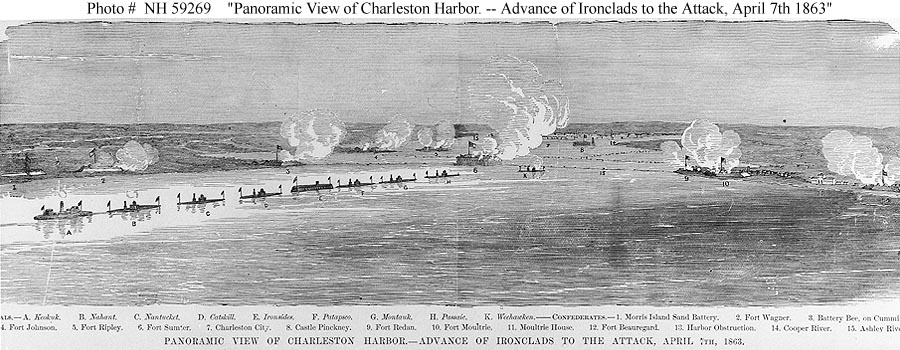
Commander Donald Fairfax on the Nantucket also passed the New Ironsides to close on Fort Sumter. But before long a Confederate shot damaged the XV-inch gun port, and the Nantucket was down to only the XI-inch gun, and even that gun limited to a dozen shots. Although under the rebel guns for only fifty minutes, the Nantucket reported fifty hits.
The Nahaut, under Commander John Downes, likewise came under heavy fire after passing the flagship. Roughly eighty projectiles hit the Nahaut. Damage to the turret prevented the monitor from firing only fifteen times. Not until the next day was the turret freed sufficiently to turn. Some of the battle scars remained on the monitor well into her postwar career - even seen in Spanish-American War photos!
Commander Alexander Rhind commanded Keokuk, last in line of battle. Finding the channel restricted and the monitors positioned so as to prevent clear firing, Rhind moved the Keokuk to the front of the line and dangerously close to Fort Sumter. There the ironclad suffered greatly. Rhind later reported, "The position taken by the Keokuk was maintained for about thirty minutes, during which period she was struck ninety times in the hull and turrets. Nineteen shots pierced her through at and just below the water line. The turrets were pierced in many places, one of the forward port shutters shot away; in short, the vessel was completely riddled." At 4:10 p.m., Rhind pulled his ship back out of line and sought refuge back down the main ship channel. Although able to anchor that evening, clearly the Keokuk was not able to make port for repairs. Early the next morning the Keokuk sank in shallow waters off Morris Island. (Which opens the storyline for another great story.)
At 4:30 p.m., DuPont signaled the monitors to withdraw from action. The Confederates would report the action continued for another hour as they fired on the withdrawing ships. At sunset, the remaining ironclads were out of range at anchor far to the south in the ship channel.
DuPont's ironclads fired just 139 times during the engagement, while the seventy-eight Confederate guns replied 2,229 times. The Federals hit Fort Sumter fifty-five times, inflicting limited damage. But with all those projectiles flying about, casualties were surprisingly light. Only one killed and twenty-one wounded. On the other side, most of the thirteen Confederate casualties were due to an accident with an ammunition chest.
By some predictions, April 7, 1863 should have proven a turning point in military history with a demonstration of the superiority of ironclad, steam-powered warships on seacoast fortifications. Instead, the lessons of Drewry's Bluff and Fort McAllister went unheeded. One non-battle casualty of the failure was the career of Admiral DuPont. In July, Rear-Admiral John Dahlgren replaced DuPont. And DuPont went on mount a vocal campaign to counter the official navy story of the action.
Charleston would not be taken by a coup de main or in a rush by naval forces. Instead the city would be the focus of protracted siege operations that even brought the war into the streets of Charleston.
Sources:
OR, Series I, Volume 14, Serial 20 – Official Confederate reports of the action are in pages 240-78.
Dispatches and correspondence appear in pages 880-90. Report of the torpedoes is on pages 948-52.
Dispatches and correspondence appear in pages 880-90. Report of the torpedoes is on pages 948-52.
ORN, Series I, Volume 14, pages 3-112.
Browning, Robert M. Success is All That Was Expected. Washington, D.C.: Brassey’s Inc., 2002.
Burton, E. Milby. The Siege of Charleston, 1861-1865. Columbia, South Carolina: University of South Carolina Press, 1970.


