Well, I finally did it. After two unsuccessful attempts to get into the holy grail of naval history, my paper was finally accepted into the 2013 McMullen Naval History Symposium. My colleague and fellow CWN 150 blogger, Gordon Calhoun, was also accepted into the symposium for his work on the USS
Cumberland. Thankfully, I went in on the diabolical scheme with two colleagues I met at the Battle of Hampton Roads Weekend in 2012, Charles Wexler and Laura Davis. Our panel,
"Forgotten Gray Jackets:" The Life and Legacy of Confederate Sailors in the Civil War, was slated to go down first thing Thursday morning.
After two long days with the Virginia Civil War HistoryMobile and the well-received lecture by acclaimed historian James McPherson earlier in the week, I was admittedly tired. Regardless of the dark circles under my eyes, I left Virginia Beach on Wednesday in high spirits and ventured towards nap town.

Annapolis is a beautiful place. Almost painfully beautiful. The Academy itself is an institution of higher learning, military base, and museum. For a student of naval history, it is the ideal place to have a conference about any and all things naval. Walking into Mahan Hall the morning of the presentation, I scanned the crowded and saw the top names of our field: Symonds, Browning, Still, Dudley, Bogle, Speelman, Holloway, etc. It was awe inspiring. I also saw something I did not expect: young faces. Graduate students and young professionals. Some I recognized, others I met for the first time. Names like Mullen, Wexler, Davis, Horney, Gale, Colamaria, Burgess, etc. Don't worry if you don't know them yet. You will soon. Although I only attended the conference on Thursday, I feel that the pulse of the two day event was the same.
9:30 arrived. Over twenty individuals packed into our panel room which felt vaguely reminiscent of a heated pool. It was so humid, I was waiting for clouds to form inside the classroom.
The first two papers were fantastic. Wexler and Davis are undoubtedly the top tier of a budding list of young and enthusiastic naval historians. As a museum educator, I can simply say that I was there for the ride, if not the shock value of my own words. It was a pleasure to be included on the same panel as they were.
For my part of the panel, I presented a paper about the role of the Confederate Navy in public memory. Although the premise of the panel concerned relatively unknown aspects of the Confederate Navy (Guerrilla Warfare and the Palmetto Navy), mine instead shifted focus on how the memory of these sailors have subsisted over the last century and a half.
My essential argument was that social media technologies, when aided by historical scholarship, is the best way to reach the wider public arena about the role of Confederate sailors in the Civil War. I used several examples where this has surfaced (for better or worse) in film, music, television, and of course, the Internet. Eighteen minutes and several beads of sweat later, my paper and the panel's presentations concluded.
Dr. Daniel Sutherland, a giant in the field of Civil War history and irregular warfare, offered up his comments to each of our presentations. Unfortunately, the hammer fell hardest on my paper. This is not upsetting, nor unexpected. My topic is unconventional. Sutherland merely questioned the paper's premise. Can all social media technologies be deemed credible? How do modern Civil War historians weigh in on this? These are all valid questions. I firmly agreed with everything he said. That was not, however, the POINT of the paper. The point was to show the ongoing narrative of history and memory and its correlation to Confederate sea service. The main measure of quantifying this (as we cannot do this with text) was the Internet. It is too early to properly measure this ABOUT the sesquicentennial commemoration DURING its last two years. In the years following 2015, many historians will undoubtedly do the scholarly work and address the major issues and concerns of the sesquicentennial. We know this. But the time is now. And the only measuring stick we have to properly address these concerns at present are popular culture mediums.
 |
| CURSES! FOILED AGAIN DO-RIGHT! |
Can we live in a world where Franklin Buchanan's image in
Hearts in Bondage looks suspiciously like Snidely Whiplash? Was this Machiavellian persona intentional? Was he and the
Virginia sent to Hampton Roads to put the wooden navy, the "Nell Fenwicks" of antebellum sea service, on the train tracks of destruction? Clearly their resemblance between the real Franklin Buchanan and the actor portraying him could not be farther apart. Dudley Do-Right references aside, these are the kinds of questions I like to ask myself from time to time. Look in the comment section on the Youtube video of the film, and you will find plenty of individuals asking similar questions. Sure, it's not necessarily HISTORY, but it does give us some insight into how people are curating their own perception of the war through various cultural mediums.

I think the biggest question that arose from my own paper was: Should we embrace this media? I find it hard to argue this, as I am using a social media technology to write this post. The life and legacy of the Confederacy can surely be found in monographs, letters, diaries, and oral histories of a one hundred and fifty year old conflict. That we know. If this was not true, historians would long be out of business. My only suggestion is that we look further into the realm of digital history to study the war. History studies the past, it doesn't have to embrace it.
------------------------------------
Of course other things occurred throughout the rest of the day: I spilled a full glass of water during the luncheon, Captain Hendrix gave a great talk during said luncheon and complimented my sideburns, and I got to shake hands and converse with many new people. I have a renewed fascination in the Barbary Wars, and I
might be convinced that
The End of the Barbary Terror was probably the best book I read in graduate school. In any case, I look forward to more fruitful conversations with scholars and enthusiasts in the years ahead.
As I said my goodbyes at the front entrance of the Naval Academy Museum Thursday night, I couldn't help but smile as I walked down the steps of the building and out of Gate 3. The smile was one of supreme satisfaction. It was not of myself, or the body of work done by this commemoration during the last three years. I smiled because, for the first time, I was in the company of ambitious men and women, both young and old, that readily acknowledge that the legacy of the Civil War is as much alive today as it was over a hundred years ago. It is the reason why I got in this business in the first place. Let me reiterate that most of the young scholars I met were women. This is a great direction for the field. The future for Civil War history and naval history is brighter than ever. I feel blessed that I got to see it in person.
Full Speed Ahead (or "four beers ahead"....or..."Four Bells"....or "Go Ahead"....or....whatever it was),
Matthew Eng


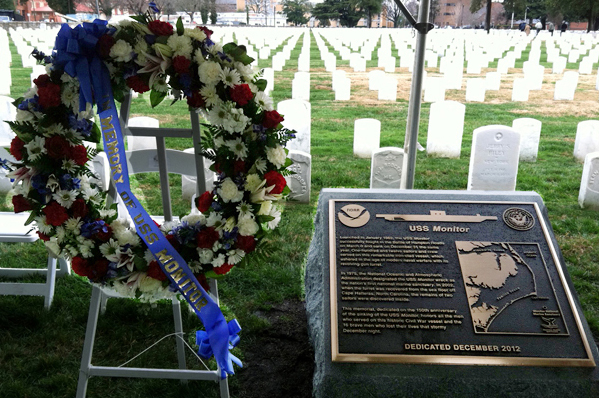
 Dozens of books about the Monitor currently line your book store's Civil War section. The majority of these published over the course of the last decade. Timeliness is next to godliness. Many monographs claim "new developments" or "uncovered history." This is perhaps an intentional play on the ship's 2002 recovery. Even after the hoopla of the ship's sesquicentennial anniversary during the Battle of Hampton Roads in 2012, books, articles, and news stories continue to surface. Far beyond the typical "15 minutes" of historical fame, the Monitor has overstayed its welcome. We are okay with that.


